从乔托到塞尚Giotto → CézanneFrom Giotto to CézanneGiotto → Cézanne

西方绘画六百年 · 十个展厅

Six centuries of Western painting · Ten rooms

从乔托到塞尚From Giotto to Cézanne

1300 年前后,一位佛罗伦萨画家让圣母第一次有了体重;1906 年,一位普罗旺斯老人还在琢磨苹果该怎么画。这六百年里,画家们一直在回答同一个问题:怎样把看见的世界放进一块平面,然后一次次推翻上一代的答案。

Around 1300, a Florentine painter gave the Virgin real weight for the first time. In 1906, an old man in Provence was still working out how to paint an apple. In the six centuries between, painters kept answering one question: how do you fit the visible world onto a flat surface? Each generation overturned the answer of the one before.

从第一展厅开始Start at Room I

画上的金色圆点可以点开细读,对比图可以左右拖动,六个技法实验台可以亲手试。

Tap the gold dots on a painting to look closer, drag the comparison sliders, and try the six technique labs yourself.

六百年,十个展厅

Six centuries, ten rooms

时间按真实比例排布。越往后变化越快:最后三个展厅挤在不到六十年里。

Drawn to scale. Change speeds up: the last three rooms fit into less than sixty years.

第 1 展厅Room 1约 1280–1400c. 1280–1400佛罗伦萨 · 帕多瓦Florence · Padua

破晓Dawn

原文艺复兴Proto-RenaissanceProto-Renaissance

中世纪的圣像追求的不是“画得像”,而是“画得对”:金色背景代表天国的光,越神圣的人物画得越大,衣褶是一套代代相传的线条程式。

乔托做了一件在当时相当冒险的事:让圣徒有体积、有重量、有表情,像真人一样待在一个可以走进去的空间里。但丁在《神曲·炼狱篇》里感叹,契马布埃曾以为自己称霸画坛,如今人人都在喊乔托的名字。

Medieval icons aimed to be correct rather than lifelike. The gold background stood for the light of heaven, holier figures were painted larger, and drapery followed line formulas handed down for generations.

Giotto took a real risk for his time. He gave saints volume, weight and expression, and placed them like real people in a space you could walk into. In the Purgatorio, Dante noted that Cimabue had thought he held the field in painting, but now Giotto had the cry.

  • 金底Gold ground

    背景铺真金箔。它不代表天空,而代表天国之光。

  • Gold ground

    Real gold leaf covered the background. It did not mean sky; it meant the light of heaven.

  • 等级比例Hierarchical scale

    按重要性而不是远近决定大小:圣母比天使大,天使比凡人大。

  • Hierarchical scale

    Size followed importance, not distance: the Virgin is bigger than the angels, and the angels bigger than mortals.

  • 体积感Modelling

    用明暗把形体“鼓”出来,让布料下面有身体,身体有重量。

  • Modelling

    Light and shade make forms swell out, so there is a body under the cloth and the body has weight.

对比滑块

Compare

同一个题材,相隔二十多年

The same subject, twenty-odd years apart

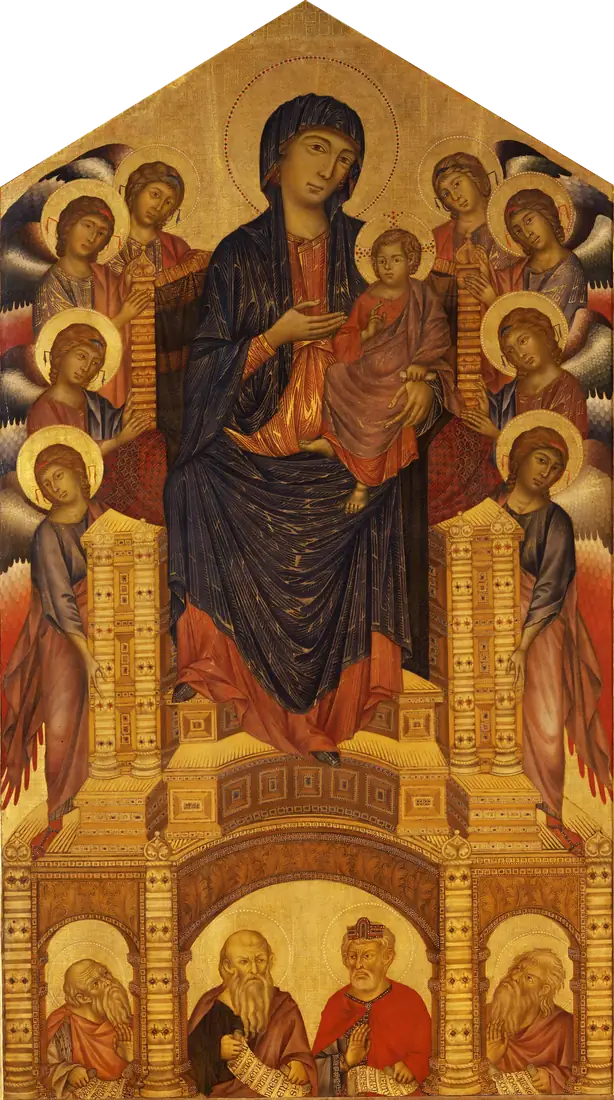
契马布埃《圣三一圣母像》
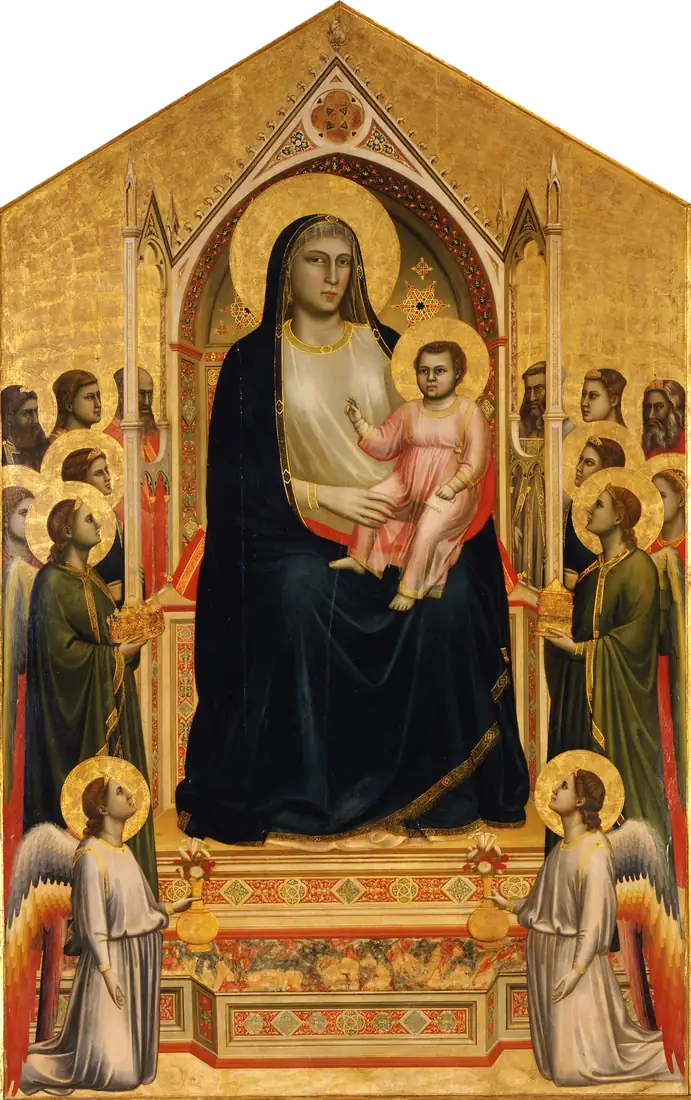
乔托《奥尼桑蒂圣母像》
契马布埃 · 约 1280–1290Cimabue · c. 1280–1290 乔托 · 约 1306–1310Giotto · c. 1306–1310

契马布埃《圣三一圣母像》约 1280–1290 · 佛罗伦萨,乌菲兹美术馆

  • 圣母的长袍上布满金线,像一层平面装饰,看不出底下的腿。
  • 天使左右对称地往上叠,像贴在金底上的剪纸。
  • 王座的各个部分各有各的透视,经不起推敲。

Cimabue, Santa Trinita Maestàc. 1280–1290 · Uffizi, Florence

  • Gold lines cover the Virgin’s robe like a flat pattern. You can’t see the legs underneath.
  • The angels stack up symmetrically on either side, like paper cut-outs pasted onto gold.
  • Each part of the throne has its own perspective, and they don’t agree.

乔托《奥尼桑蒂圣母像》约 1306–1310 · 佛罗伦萨,乌菲兹美术馆

  • 袍子下能看出膝盖和大腿,圣母真的“坐”在王座上。
  • 王座是一座有深度的哥特式小建筑,两侧能看到侧面。
  • 前排的天使挡住了后排,画面第一次有了前后。

Giotto, Ognissanti Madonnac. 1306–1310 · Uffizi, Florence

  • Knees and thighs show through the robe. The Virgin really sits on the throne.
  • The throne is a small Gothic structure with depth; you can see its sides.
  • The angels in front block the ones behind. For the first time the picture has a front and a back.

在乌菲兹美术馆,这两幅画和杜乔的《鲁切拉伊圣母》挂在同一个展厅,三幅并排,是看这次转变最好的地方。

At the Uffizi these two hang in the same room as Duccio’s Rucellai Madonna. Seeing the three side by side is the best way to see this change.

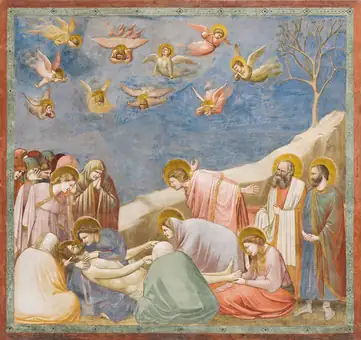
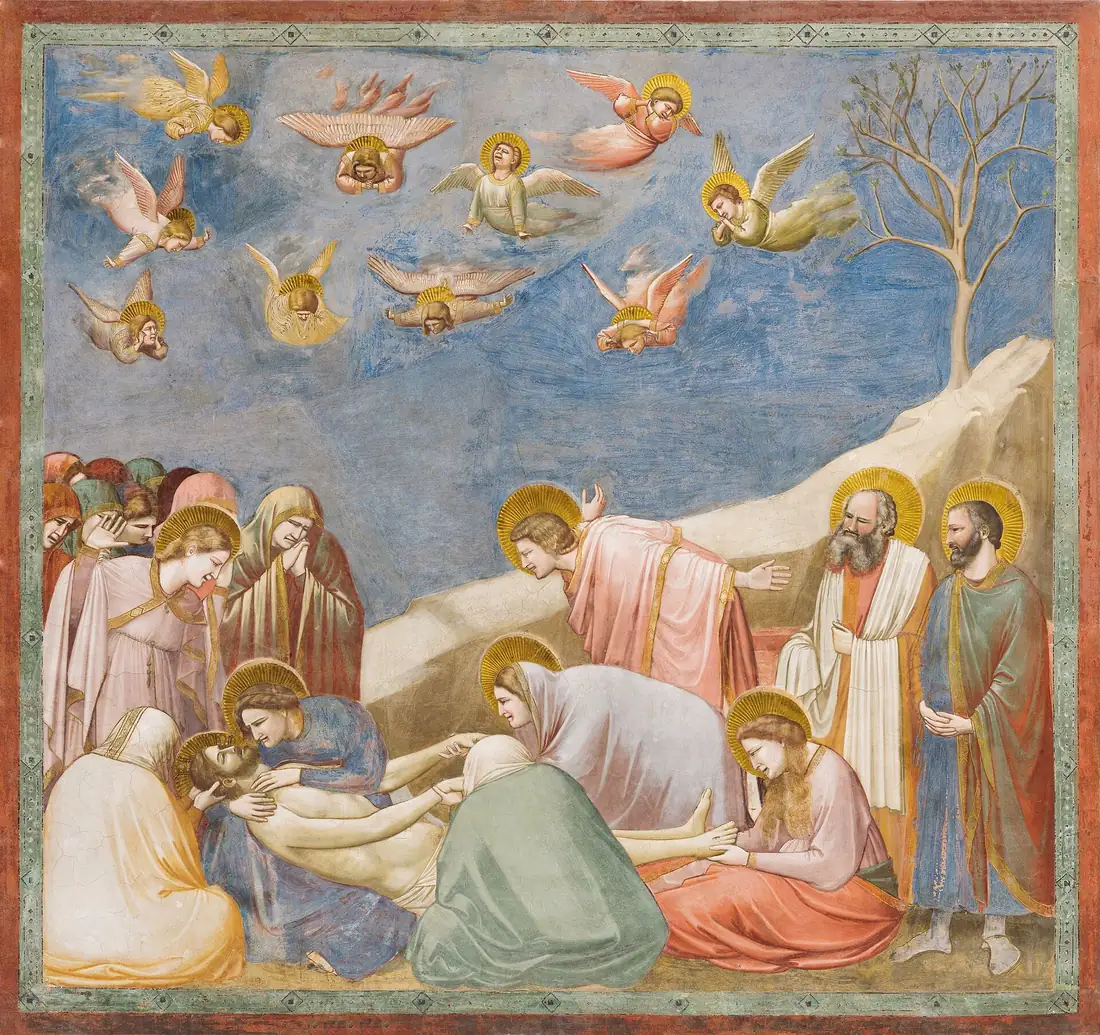
乔托《哀悼基督》

哀悼基督Lamentation (The Mourning of Christ)Compianto sul Cristo morto

乔托 Giotto di Bondone
约 1305 年 · 湿壁画 · 200 × 185 cm
帕多瓦,斯克罗韦尼礼拜堂

Giotto di Bondone
c. 1305 · Fresco · 200 × 185 cm
Scrovegni Chapel, Padua

在斯克罗韦尼礼拜堂的四壁,乔托画了近四十个圣经场景,像一部连环画。这一幕是整部故事里情绪最重的一页。

Around the walls of the Scrovegni Chapel, Giotto painted nearly forty scenes from the Bible, like a picture book. This is the most emotionally heavy page of the whole story.
第 2 展厅Room 21400–1490佛罗伦萨 · 乌尔比诺Florence · Urbino

透视Perspective

早期文艺复兴Early RenaissanceEarly Renaissance

1420 年前后,建筑师布鲁内莱斯基在佛罗伦萨大教堂门口做了个实验:他照着对面的洗礼堂画了一块小画板,在画板中央钻了个孔,让人从背面透过小孔去看镜子里的画,再移开镜子对照真景。画与真实的洗礼堂严丝合缝。

十几年后,阿尔贝蒂在《论绘画》(1435)里把规则写了下来,还留下一个比喻:画面是一扇打开的窗。

Around 1420 the architect Brunelleschi ran an experiment at the door of Florence Cathedral. He painted the Baptistery opposite on a small panel and drilled a hole in its centre. A viewer looked through the hole from the back at a mirror reflecting the painting, then the mirror was taken away to compare with the real building. Painting and Baptistery matched exactly.

A decade or so later, Alberti wrote the rules down in On Painting (1435) and left a metaphor behind: a picture is an open window.

  • 消失点Vanishing point

    平行线在远方汇聚的那一点,落在观者眼睛的高度上。

  • Vanishing point

    The point where parallel lines meet in the distance. It sits at the viewer’s eye level.

  • 地平线Horizon line

    就是你眼睛的高度。和你一样高的人,无论远近,头顶都落在这条线上。

  • Horizon line

    Your own eye level. Anyone as tall as you, near or far, has their head on this line.

  • 人文主义Humanism

    重读古希腊罗马的著作、研究古代雕像,把“人”放回世界的中心。

  • Humanism

    Rereading Greek and Roman writers and studying ancient statues put people back at the centre of the world.

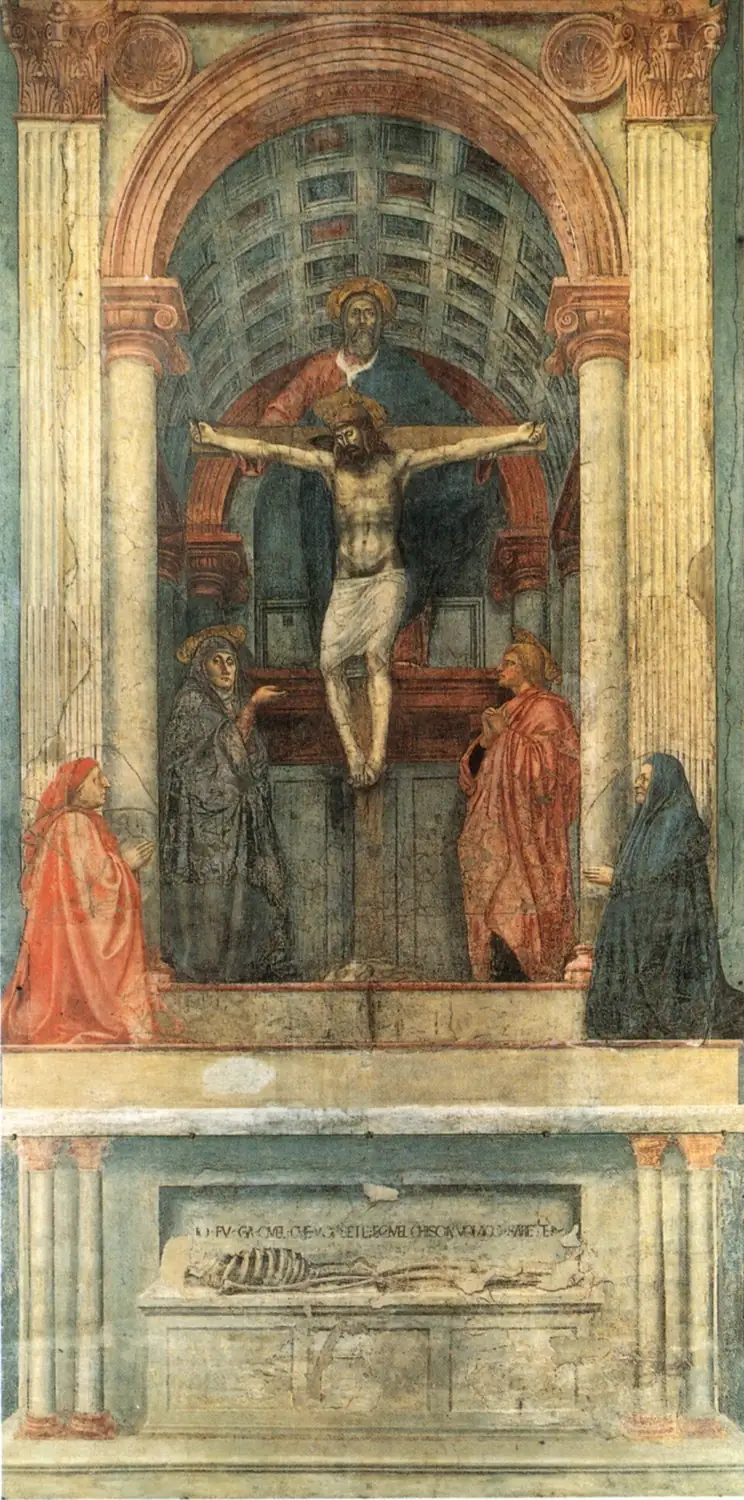
马萨乔《圣三位一体》

圣三位一体The Holy TrinitySanta Trinità

马萨乔 Masaccio
约 1427 年 · 湿壁画 · 667 × 317 cm
佛罗伦萨,新圣母大殿

Masaccio
c. 1427 · Fresco · 667 × 317 cm
Santa Maria Novella, Florence

马萨乔去世时只有 26 岁。这面墙是现存最早严格按线性透视画成的大型绘画之一:站在教堂里看,墙面像被凿开了一个礼拜堂。

Masaccio died at just 26. This wall is one of the earliest large paintings made strictly in linear perspective: from inside the church, it looks as if a chapel had been carved into the wall.

实验台

Lab

透视实验台

Perspective lab

拖动金色的消失点。地平线跟着它走:它就是你眼睛的高度。

Drag the gold vanishing point. The horizon moves with it: it is your eye level.

阿尔贝蒂的作图法:先把地面的底边等分,每个分点连向消失点,得到一排向深处汇聚的“正交线”;再确定每一排横线的位置,地砖就一格格缩小下去。

他还留下一个检验办法:画一条对角线,如果它正好穿过一连串地砖的对角,透视就画对了。

Alberti’s construction: divide the base of the floor into equal parts and join each point to the vanishing point. That gives a row of orthogonals converging into the depth. Then fix where each row of horizontals goes, and the tiles shrink row by row.

He also left a test: draw a diagonal. If it passes exactly through the corners of a run of tiles, the perspective is right.

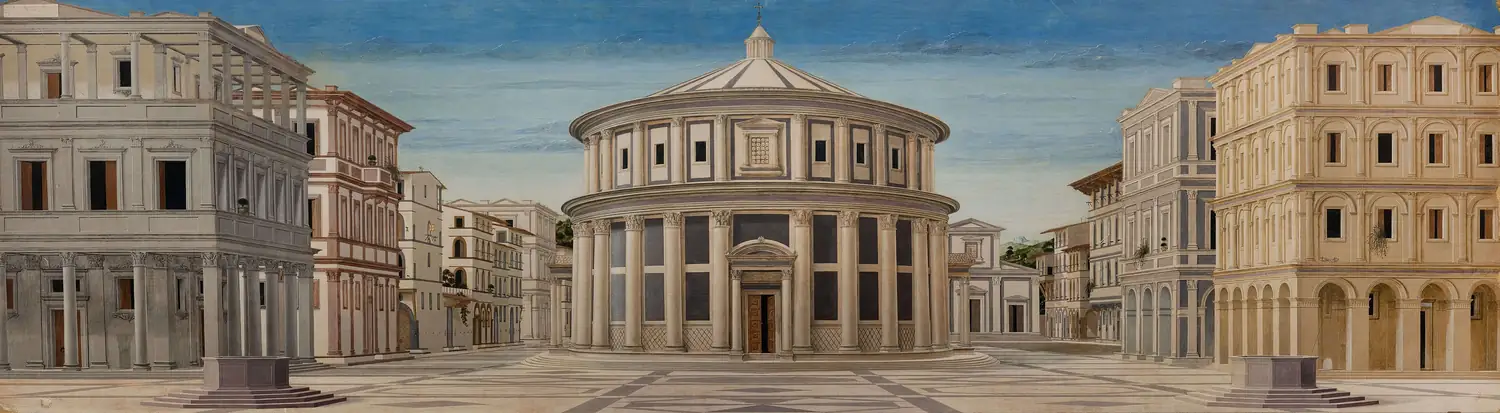
佚名(曾被归于皮耶罗·德拉·弗朗切斯卡)《理想城》

理想城The Ideal CityLa città ideale

佚名(曾被归于皮耶罗·德拉·弗朗切斯卡) Anonymous, central Italy
约 1480–1490 年 · 木板蛋彩 · 67.7 × 239.4 cm
乌尔比诺,马尔凯国家美术馆

Anonymous (formerly attributed to Piero della Francesca)
c. 1480–1490 · Tempera on panel · 67.7 × 239.4 cm
Galleria Nazionale delle Marche, Urbino

画里没有一个人,真正的主角是透视本身:广场、地砖、建筑全部服从同一套几何秩序。这是文艺复兴心目中“完美城市”的样子。

There is not a single person in it. The real subject is perspective itself: square, paving and buildings all obey one geometric order. This is the Renaissance idea of a perfect city.

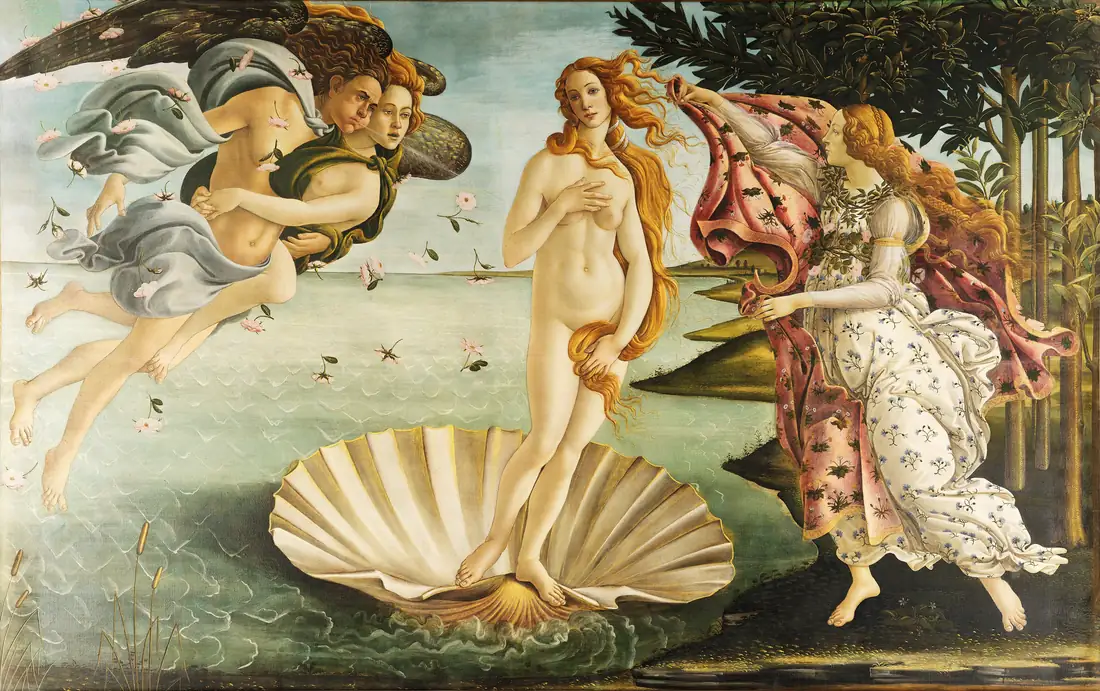
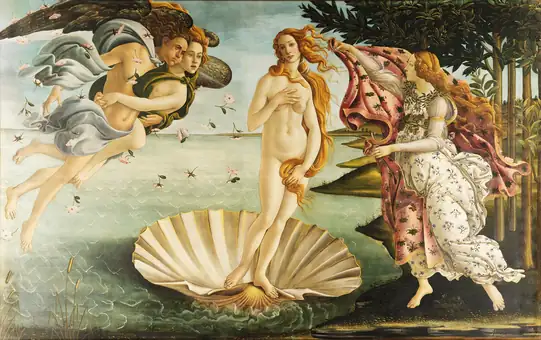
桑德罗·波提切利《维纳斯的诞生》

维纳斯的诞生The Birth of VenusNascita di Venere

桑德罗·波提切利 Sandro Botticelli
约 1484–1486 年 · 画布蛋彩 · 172.5 × 278.9 cm
佛罗伦萨,乌菲兹美术馆

Sandro Botticelli
c. 1484–1486 · Tempera on canvas · 172.5 × 278.9 cm
Uffizi, Florence

这是古代之后最早以异教女神裸体为主角的大幅画作之一,很可能为美第奇家族的成员而画,迎合了一群熟读柏拉图的佛罗伦萨知识分子。

This is one of the first large paintings since antiquity to centre on a nude pagan goddess. It was probably painted for a member of the Medici family, for a circle of Florentine intellectuals steeped in Plato.

第 3 展厅Room 31490–1527米兰 · 佛罗伦萨 · 罗马Milan · Florence · Rome

巨匠The Masters

盛期文艺复兴High RenaissanceHigh Renaissance

短短三十多年里,达·芬奇、米开朗基罗和拉斐尔把前辈们的发明推到了顶峰:透视、解剖、光影、构图,全都服务于一个和谐、宏大、看起来毫不费力的整体。

1527 年,神圣罗马帝国的军队洗劫罗马,这个黄金时代戛然而止。

In barely thirty years, Leonardo, Michelangelo and Raphael took their predecessors’ inventions to a peak. Perspective, anatomy, light and composition all served a harmonious, monumental whole that looks effortless.

In 1527 the troops of the Holy Roman Empire sacked Rome, and the golden age ended abruptly.

  • 晕涂法Sfumato

    意大利语“像烟一样”。不勾轮廓线,用极薄的层层过渡,让边缘消失在阴影里。

  • Sfumato

    Italian for “like smoke”. No outlines; very thin layers blend so that edges dissolve into shadow.

  • 湿壁画Fresco

    趁灰泥未干时上色,颜料和墙一起凝固。每天只能画一块,画错只能铲掉重来。

  • Fresco

    Paint goes onto wet plaster and sets with the wall. Only one patch can be painted a day, and mistakes have to be chipped off.

  • 金字塔构图Pyramidal composition

    人物组成稳定的三角形,是盛期文艺复兴最爱的秩序。

  • Pyramidal composition

    Figures arranged in a stable triangle, the favourite order of the High Renaissance.

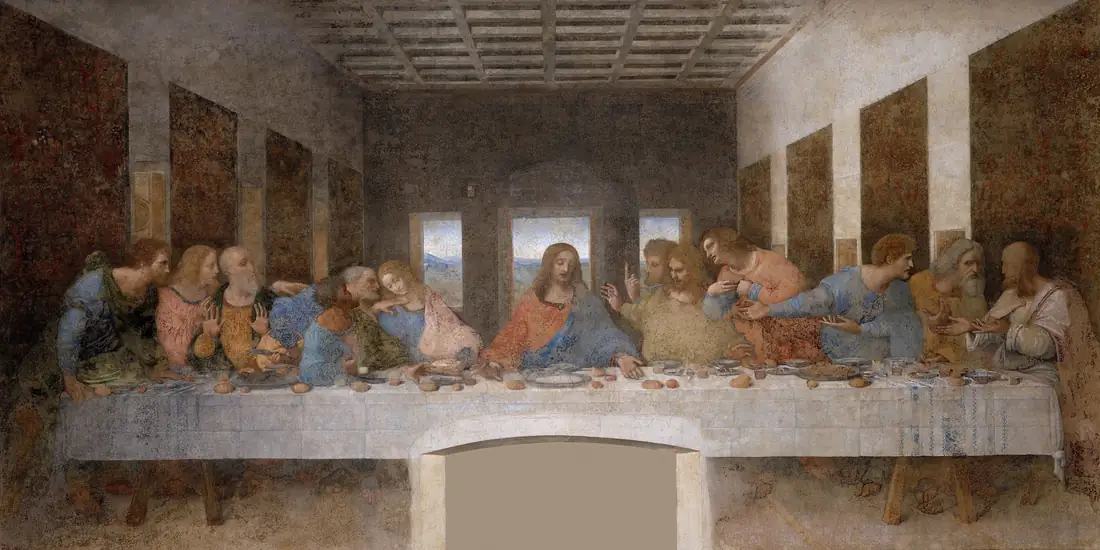
列奥纳多·达·芬奇《最后的晚餐》

最后的晚餐The Last SupperL’Ultima Cena

列奥纳多·达·芬奇 Leonardo da Vinci
1495–1498 年 · 石膏墙面上的蛋彩与油彩 · 460 × 880 cm
米兰,感恩圣母教堂修道院食堂

Leonardo da Vinci
1495–1498 · Tempera and oil on plaster · 460 × 880 cm
Refectory of Santa Maria delle Grazie, Milan

它画在修士们吃饭的食堂墙上,修士们抬头就能看见耶稣和门徒“与自己同桌”。画中定格的,是耶稣说出“你们中间有一个人要出卖我”之后的那一刻。

It is painted on the wall of the monks’ dining hall, so when they looked up they saw Christ and the apostles at table with them. It freezes the moment after Christ says: “One of you will betray me.”

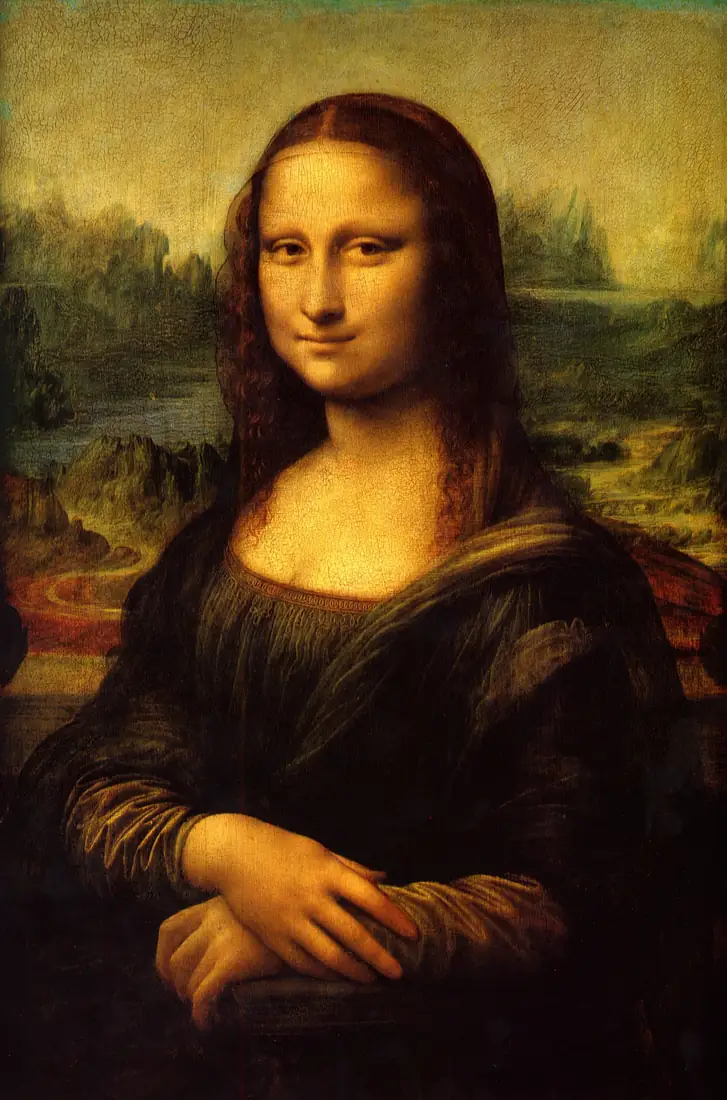
列奥纳多·达·芬奇《蒙娜丽莎》

蒙娜丽莎Mona LisaLa Gioconda

列奥纳多·达·芬奇 Leonardo da Vinci
约 1503–1519 年 · 白杨木板油画 · 77 × 53 cm
巴黎,卢浮宫

Leonardo da Vinci
c. 1503–1519 · Oil on poplar panel · 77 × 53 cm
Louvre, Paris

画中人一般认为是佛罗伦萨丝绸商人的妻子丽莎·盖拉尔迪尼。达·芬奇始终没有把画交给委托人,而是带着它辗转米兰、罗马,最后到了法国,断断续续改了十几年。

The sitter is generally identified as Lisa Gherardini, the wife of a Florentine silk merchant. Leonardo never handed the painting over. He took it with him to Milan, Rome and finally France, reworking it on and off for more than a decade.

实验台

Lab

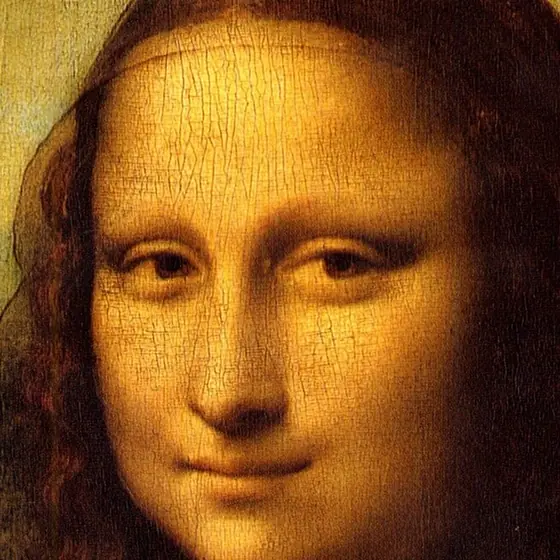
蒙娜丽莎的微笑实验

The Mona Lisa smile

拖动滑块模糊画面,模拟你用余光看她。

Drag the slider to blur the image and see her as if from the corner of your eye.

《蒙娜丽莎》面部局部

哈佛神经科学家玛格丽特·利文斯通在 2000 年提出:蒙娜丽莎的笑意主要藏在嘴角和脸颊大片柔和的阴影里,这种粗略的明暗信息正是余光最擅长捕捉的。

直视时,眼睛看到的是清晰的嘴唇细节,笑容反而不明显。所以她的笑会“一看就消失”。

In 2000 the Harvard neuroscientist Margaret Livingstone proposed that most of the Mona Lisa’s smile lies in the broad, soft shadows around her mouth and cheeks, the kind of coarse light-and-dark information that peripheral vision picks up best.

When you look straight at her, your eye sees the sharp detail of the lips and the smile is less obvious. That is why her smile seems to vanish the moment you look at it.

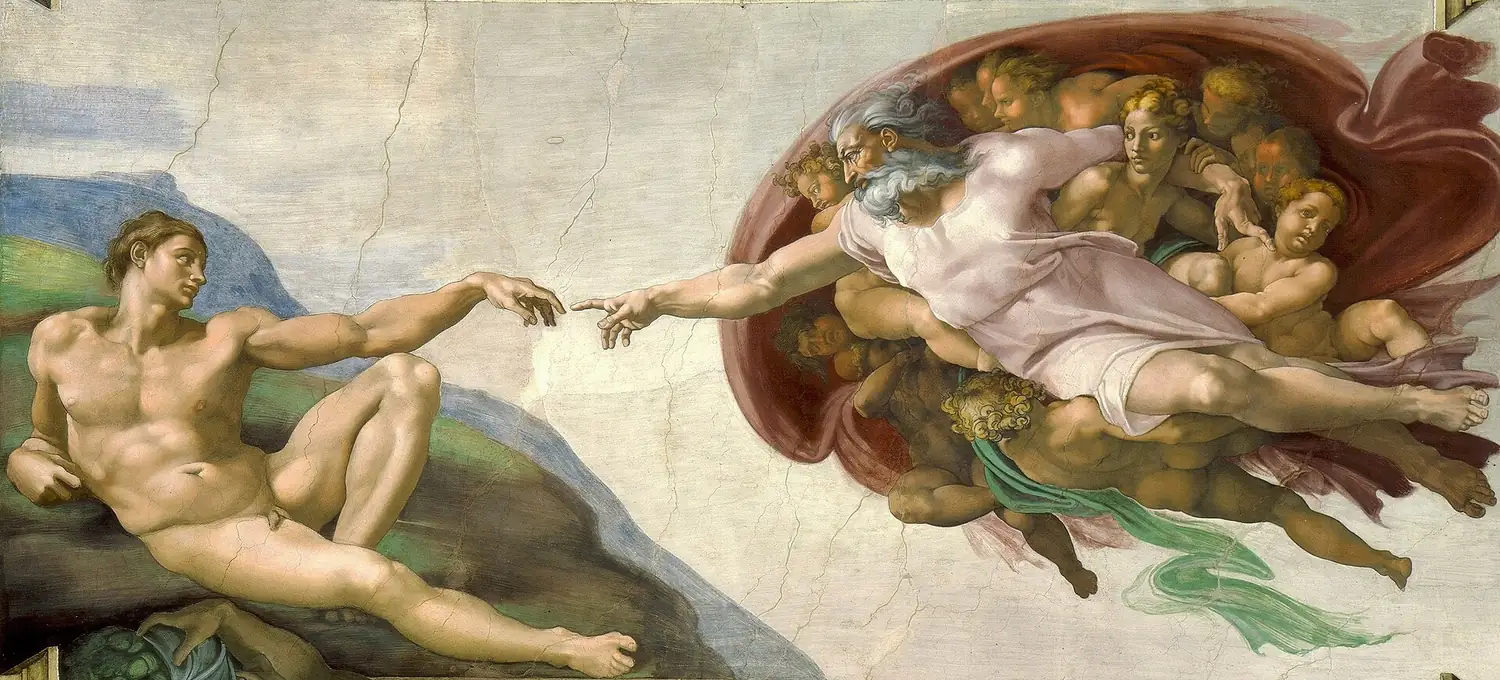
米开朗基罗《创造亚当》

创造亚当The Creation of AdamCreazione di Adamo

米开朗基罗 Michelangelo Buonarroti
约 1508–1512 年 · 湿壁画 · 280 × 570 cm
梵蒂冈,西斯廷礼拜堂天顶

Michelangelo
c. 1508–1512 · Fresco · 280 × 570 cm
Sistine Chapel ceiling, Vatican

米开朗基罗一直自称是雕塑家而不是画家,却站在脚手架上仰着头,用四年画完了五百多平方米的天顶。这是天顶中央九幅创世纪场景里的一幅。

Michelangelo always called himself a sculptor, not a painter, yet he spent four years on scaffolding, head tilted back, painting more than 500 square metres of ceiling. This is one of the nine scenes from Genesis down its centre.

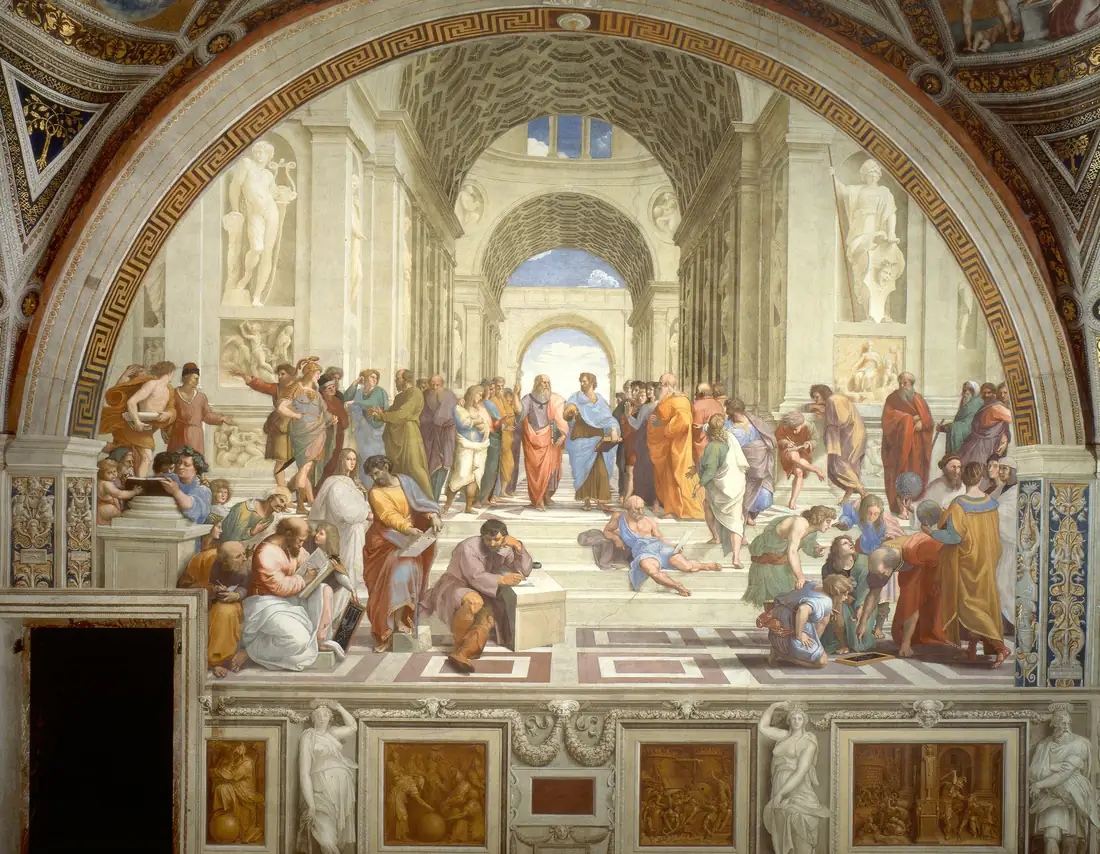
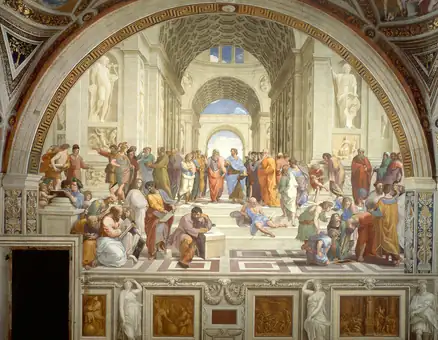
拉斐尔《雅典学院》

雅典学院The School of AthensScuola di Atene

拉斐尔 Raffaello Sanzio
1509–1511 年 · 湿壁画 · 500 × 770 cm
梵蒂冈,使徒宫签字厅

Raphael
1509–1511 · Fresco · 500 × 770 cm
Stanza della Segnatura, Apostolic Palace, Vatican

画这幅画时,拉斐尔才二十多岁。他把几十位古希腊哲学家、数学家安排进一座宏伟的罗马式大厅,还让好几位同时代的艺术家来“客串”。

Raphael was in his twenties when he painted this. He placed dozens of Greek philosophers and mathematicians in a grand Roman hall, and gave several contemporary artists cameo roles.

第 4 展厅Room 41420–1570布鲁日 · 纽伦堡 · 安特卫普Bruges · Nuremberg · Antwerp

显微Up Close

北方文艺复兴Northern RenaissanceNorthern Renaissance

当意大利人在计算透视的时候,阿尔卑斯山以北的画家迷上了另一件事:细节。他们用油彩一层层罩染,画出金属的冷光、毛皮的柔软、玻璃上的倒影。

这里也是宗教改革风暴的中心。画家的题材从教堂一步步走向家庭、市场和田野。

While the Italians calculated perspective, painters north of the Alps fell for something else: detail. Layer by layer in oil glazes, they painted the cold gleam of metal, the softness of fur and reflections in glass.

This was also the centre of the Reformation storm. Step by step, painters’ subjects moved from the church to the home, the market and the field.

  • 罩染Glazing

    在干透的底色上刷一层薄而透明的油彩,再刷一层……光穿过颜色、碰到白底再反射回来,色彩像宝石一样有深度。

  • Glazing

    Over a dry underlayer you brush a thin, transparent layer of oil paint, then another. Light passes through the colour, hits the white ground and comes back, giving jewel-like depth.

  • 隐藏的象征Disguised symbolism

    日常物件里暗藏寓意:一支蜡烛、一只小狗、几个橙子,都可能“有话要说”。

  • Disguised symbolism

    Everyday objects carry hidden meanings: a candle, a little dog or a few oranges may all be saying something.

  • 风俗画Genre painting

    画普通人的日常生活,而不是神话或圣经故事。

  • Genre painting

    Pictures of ordinary people’s daily life rather than myths or Bible stories.

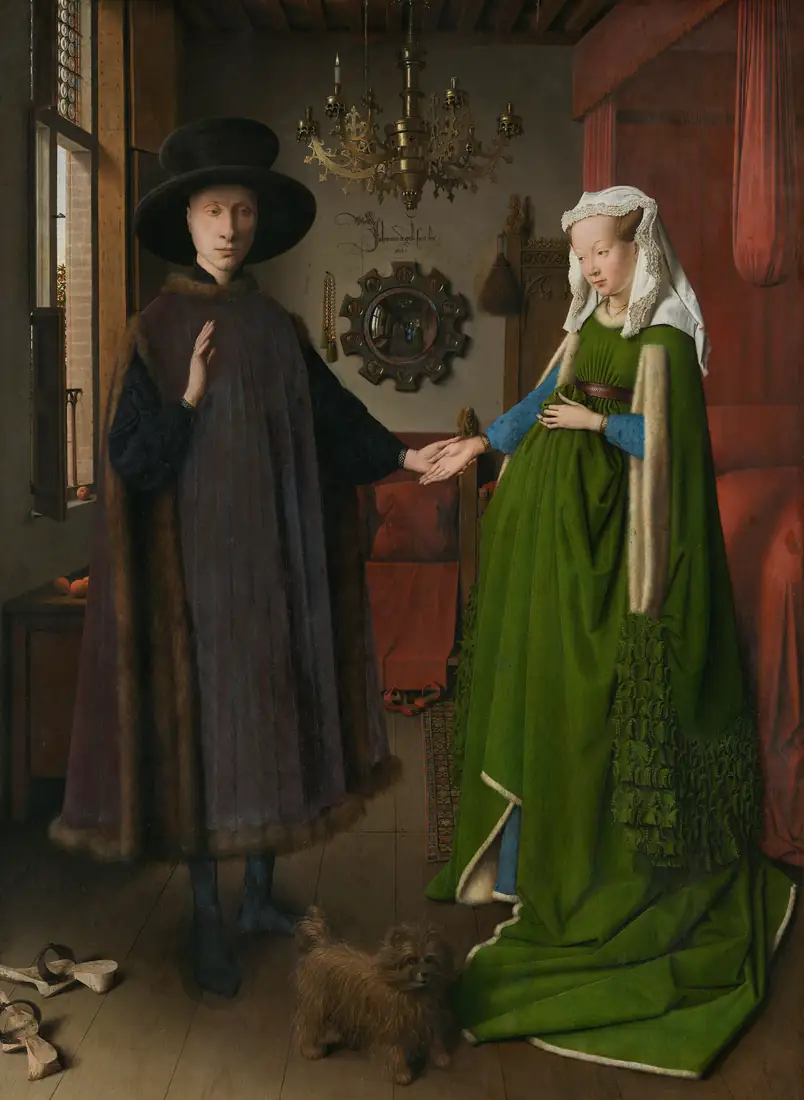
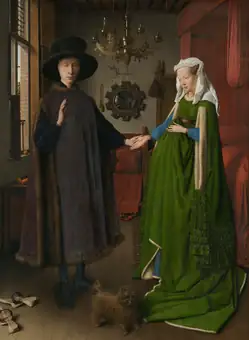
扬·凡·艾克《阿尔诺芬尼夫妇像》

阿尔诺芬尼夫妇像The Arnolfini PortraitPortret van Giovanni Arnolfini en zijn vrouw

扬·凡·艾克 Jan van Eyck
1434 年 · 橡木板油画 · 82.2 × 60 cm
伦敦,英国国家美术馆

Jan van Eyck
1434 · Oil on oak panel · 82.2 × 60 cm
National Gallery, London

画中是在布鲁日经商的意大利人乔瓦尼·阿尔诺芬尼和他的妻子。这究竟是婚礼、订婚,还是一幅纪念像,学者们争论了将近一百年。凡·艾克并没有发明油画,但他把油画技法推到了前所未有的精度。

It shows Giovanni Arnolfini, an Italian merchant in Bruges, and his wife. Whether it records a wedding, a betrothal or is a memorial portrait has been argued for nearly a century. Van Eyck did not invent oil painting, but he took its technique to an unprecedented precision.
实验台

Lab

罩染实验台

Glazing lab

一层层叠加透明色,比较“罩染”和“直接调和”。

Stack transparent colours layer by layer, and compare glazing with direct mixing.

罩染Glazing透明薄层一层层叠加thin transparent layers, one on another
直接调和Direct mixing同样的颜料加铅白一次调匀the same pigments mixed with lead white

罩染时,光穿过每一层颜色,到达白色底层后再穿回来:每层颜料都被光经过两次。所以叠得越多,颜色越深、越饱和,却依然透亮。

把同样的颜料和铅白调成不透明的颜色,光只在表面反射,看起来就“粉”而“闷”。阿尔诺芬尼夫人的绿裙,就是在浅色底上一层层罩染铜绿画成的。

When you glaze, light passes through every layer of colour, reaches the white ground and comes back out: it crosses each layer twice. So the more layers, the deeper and richer the colour, and it still glows.

Mix the same pigments with lead white into opaque paint and light only bounces off the surface, so the colour looks chalky and dull. Mrs Arnolfini’s green dress was built up from verdigris glazes over a light ground.

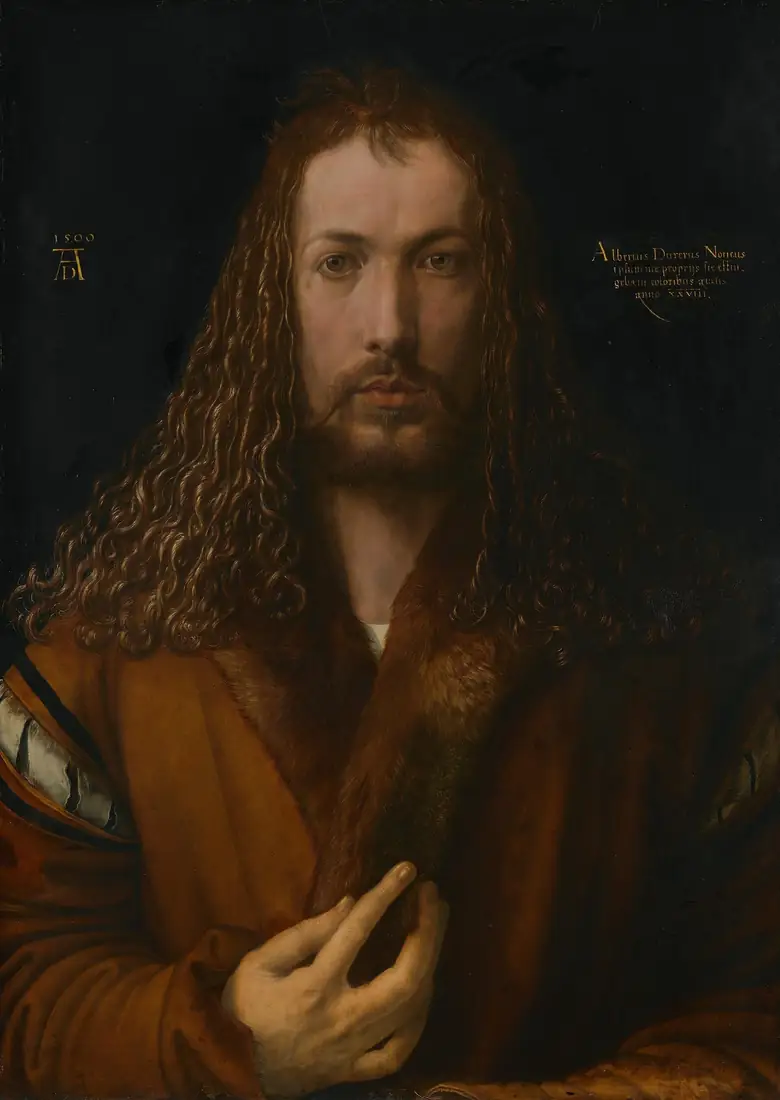
阿尔布雷希特·丢勒《1500 年自画像》

1500 年自画像Self-Portrait at 28Selbstbildnis im Pelzrock

阿尔布雷希特·丢勒 Albrecht Dürer
1500 年 · 椴木板油画 · 67.1 × 48.9 cm
慕尼黑,老绘画陈列馆

Albrecht Dürer
1500 · Oil on lime panel · 67.1 × 48.9 cm
Alte Pinakothek, Munich

28 岁的丢勒把自己画成了前所未有的样子:完全正面、左右对称、直视观众。这种构图在当时几乎只用来画基督。艺术家第一次如此自信地宣告:我不只是工匠。

At 28, Dürer painted himself as no one had before: fully frontal, symmetrical, looking straight at the viewer. At the time this composition was used almost only for Christ. An artist was declaring, with new confidence, that he was more than a craftsman.

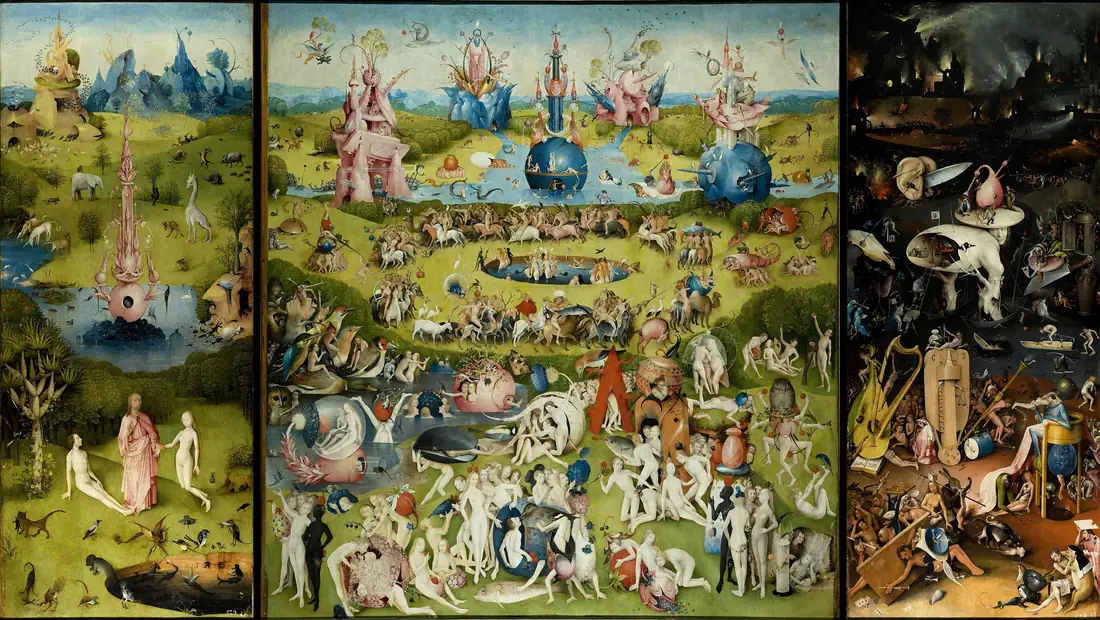
希罗尼穆斯·博斯《人间乐园》

人间乐园The Garden of Earthly DelightsDe tuin der lusten

希罗尼穆斯·博斯 Hieronymus Bosch
约 1490–1510 年 · 橡木板油画(三联画) · 205.5 × 384.9 cm
马德里,普拉多博物馆

Hieronymus Bosch
c. 1490–1510 · Oil on oak panels (triptych) · 205.5 × 384.9 cm
Museo del Prado, Madrid

三块画板从左到右,讲了一个人类的故事:伊甸园、人间的放纵、地狱的惩罚。五百年来,没有人能把它完全读懂。

Read from left to right, the three panels tell a human story: the Garden of Eden, earthly indulgence, and the punishments of hell. For five hundred years no one has fully decoded it.

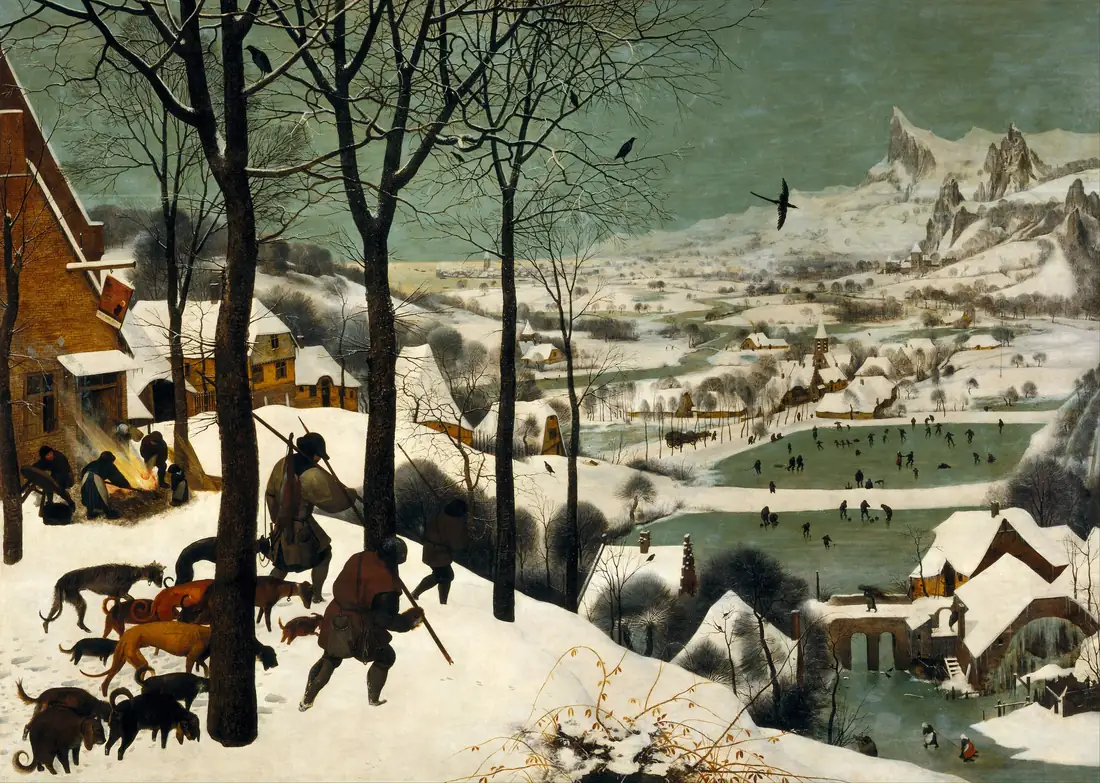
老彼得·勃鲁盖尔《雪中猎人》

雪中猎人The Hunters in the SnowDe jagers in de sneeuw

老彼得·勃鲁盖尔 Pieter Bruegel the Elder
1565 年 · 橡木板油画 · 117 × 162 cm
维也纳,艺术史博物馆

Pieter Bruegel the Elder
1565 · Oil on oak panel · 117 × 162 cm
Kunsthistorisches Museum, Vienna

这是勃鲁盖尔为一位安特卫普富商画的“季节”组画之一,原本可能有六幅,现存五幅。他画的不是英雄,而是一个村庄的冬天。

This is one of a series of seasons Bruegel painted for an Antwerp merchant; there may have been six, and five survive. He painted not heroes but a village in winter.

第 5 展厅Room 51600–1700罗马 · 阿姆斯特丹 · 马德里 · 代尔夫特Rome · Amsterdam · Madrid · Delft

戏剧Drama

巴洛克BaroqueBaroque

宗教改革之后,天主教会需要能直击人心的图像;新兴的荷兰共和国里,商人和市民开始买画挂在自己家中。

巴洛克的回答是戏剧:强烈的明暗、倾斜的构图、定格在最紧张的一瞬。画面不再是一扇安静的窗,而是一个打着聚光灯的舞台。

After the Reformation, the Catholic Church wanted images that went straight to the heart. In the new Dutch Republic, merchants and townspeople began buying paintings for their own homes.

The Baroque answer was drama: strong light and dark, tilted compositions, the tensest moment frozen. The picture was no longer a quiet window but a stage under a spotlight.

  • 暗色调主义Tenebrism

    卡拉瓦乔式的极端明暗:背景几乎全黑,一束光从侧面劈进来。

  • Tenebrism

    Caravaggio’s extreme contrast: an almost black background, with a shaft of light cutting in from the side.

  • 明暗对照Chiaroscuro

    意大利语“明—暗”。用光影塑造立体感,伦勃朗是公认的大师。

  • Chiaroscuro

    Italian for “light–dark”. Modelling form with light and shadow; Rembrandt is its acknowledged master.

  • 反宗教改革Counter-Reformation

    天主教会对新教改革的回应,鼓励情感强烈、一看就懂的宗教艺术。

  • Counter-Reformation

    The Catholic response to Protestant reform, which encouraged emotional religious art that anyone could understand.

对比滑块

Compare

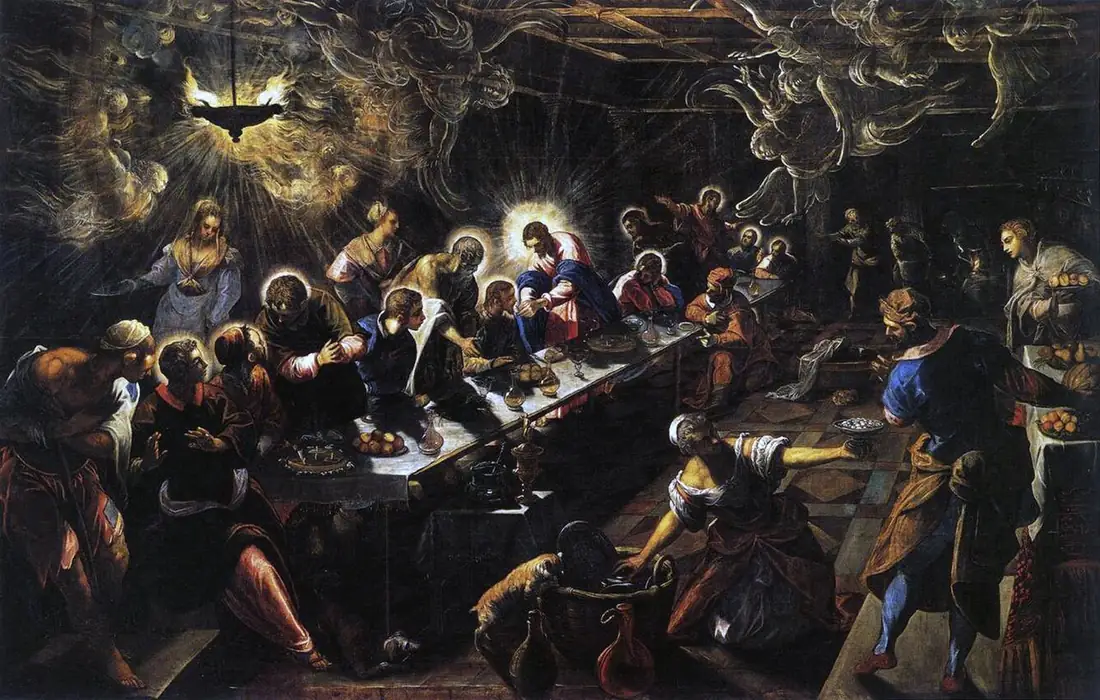
同一场晚餐,相隔一百年

The same supper, a century apart

列奥纳多·达·芬奇《最后的晚餐》
丁托列托《最后的晚餐》
达·芬奇 · 1495–1498Leonardo da Vinci · 1495–1498 丁托列托 · 1592–1594Tintoretto · 1592–1594

达·芬奇《最后的晚餐》1495–1498 · 米兰,感恩圣母教堂

  • 桌子与画面平行,耶稣坐在绝对的正中。
  • 光线平均,门徒左右对称地排开。
  • 一切都安放在清晰、稳定的秩序里。

Leonardo da Vinci, The Last Supper1495–1498 · Santa Maria delle Grazie, Milan

  • The table runs parallel to the picture, with Christ at the exact centre.
  • The light is even, and the apostles spread out symmetrically.
  • Everything sits in a clear, stable order.
丁托列托《最后的晚餐》1592–1594 · 威尼斯,圣乔治马焦雷教堂

  • 长桌斜着冲进画面深处,耶稣在光里,却不在正中。
  • 一盏油灯和耶稣头上的光,把房间照得忽明忽暗。
  • 半透明的天使从烟雾里涌出,前景的仆人照常忙碌,神圣与世俗挤在同一个房间。

Tintoretto, The Last Supper1592–1594 · San Giorgio Maggiore, Venice

  • The long table plunges diagonally into the depth. Christ is in the light but not at the centre.
  • An oil lamp and the glow around Christ’s head make the room flicker between light and dark.
  • Translucent angels pour out of the smoke while servants in front carry on working. Sacred and everyday share one room.

丁托列托属于威尼斯文艺复兴晚期,但这幅画里的斜线、暗影和动势,已经预告了巴洛克的到来。

Tintoretto belongs to the late Venetian Renaissance, but the diagonals, shadows and movement of this painting already announce the Baroque.

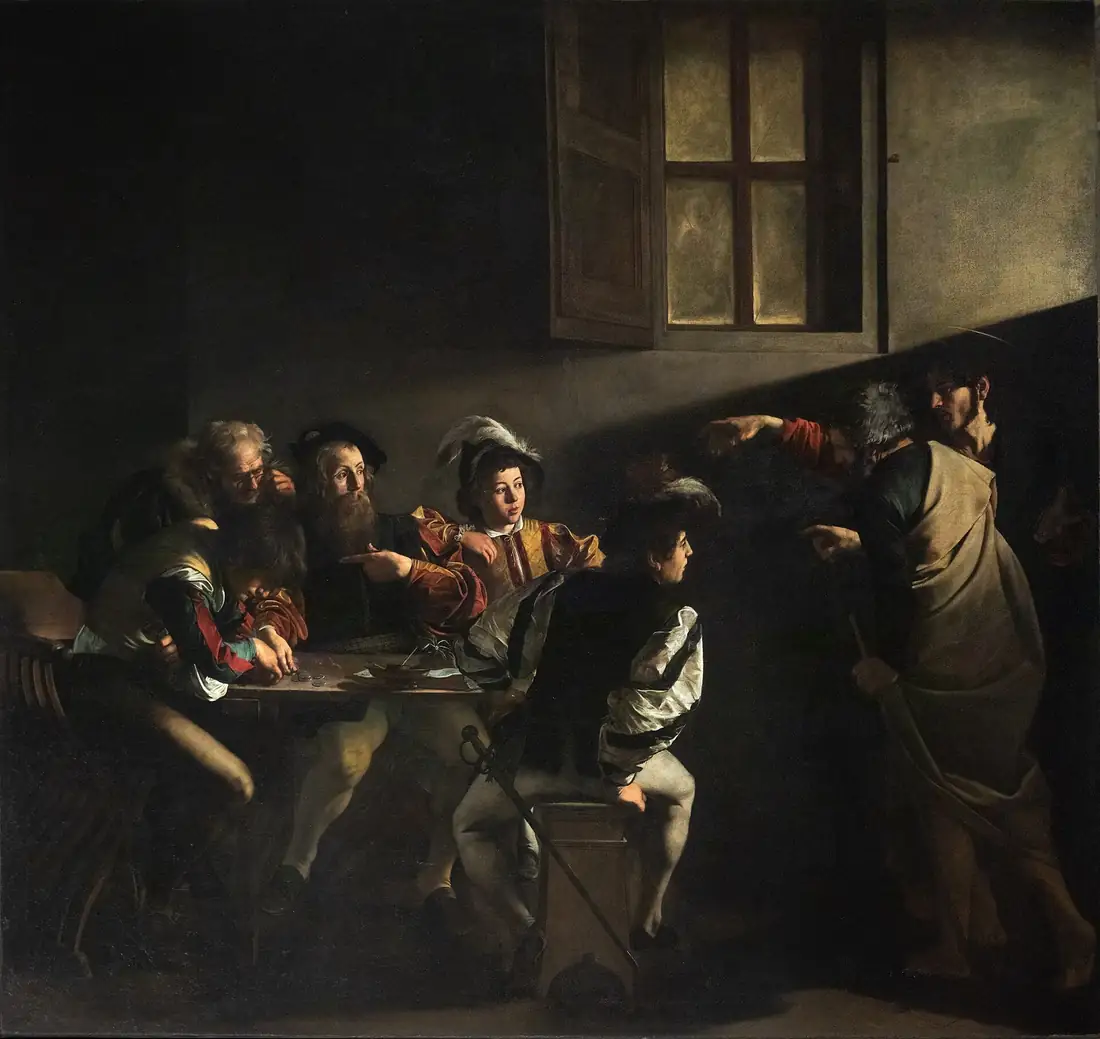
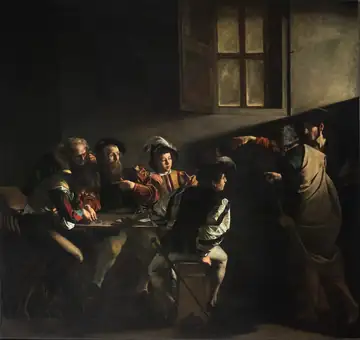
卡拉瓦乔《圣马太蒙召》

圣马太蒙召The Calling of Saint MatthewVocazione di san Matteo

卡拉瓦乔 Caravaggio
1599–1600 年 · 布面油画 · 322 × 340 cm
罗马,圣王路易堂

Caravaggio
1599–1600 · Oil on canvas · 322 × 340 cm
San Luigi dei Francesi, Rome

这是卡拉瓦乔第一件公开展出的大型教堂委托,一挂出来就轰动了罗马。圣经故事发生在一间昏暗的税务所里,人们穿的都是 1600 年罗马街头的衣服。

This was Caravaggio’s first big public church commission, and it caused a sensation in Rome. The Bible story takes place in a dim tax office, with everyone in the street clothes of Rome in 1600.

实验台

Lab

明暗实验台

Light and shadow lab

在画面里拖动光源;用滑块把“柔光”调成“暗色调”。

Drag the light source around the picture, and use the slider to go from soft light to tenebrism.

环境光越多,阴影越浅,形体越平均,接近文艺复兴绘画的柔和光线。把环境光关掉,只留一束斜射的强光,背景沉入黑暗,物体像从黑暗中“跳”出来,这就是卡拉瓦乔的暗色调主义。

伦勃朗更进一步,让光有选择地落在人群里:光决定了谁被看见,谁隐没。

The more ambient light, the paler the shadows and the more even the forms, close to the soft light of Renaissance painting. Turn the ambient light off and leave a single slanting beam: the background sinks into darkness and the objects jump out of it. That is Caravaggio’s tenebrism.

Rembrandt went further and let light fall selectively across a crowd: the light decides who is seen and who disappears.

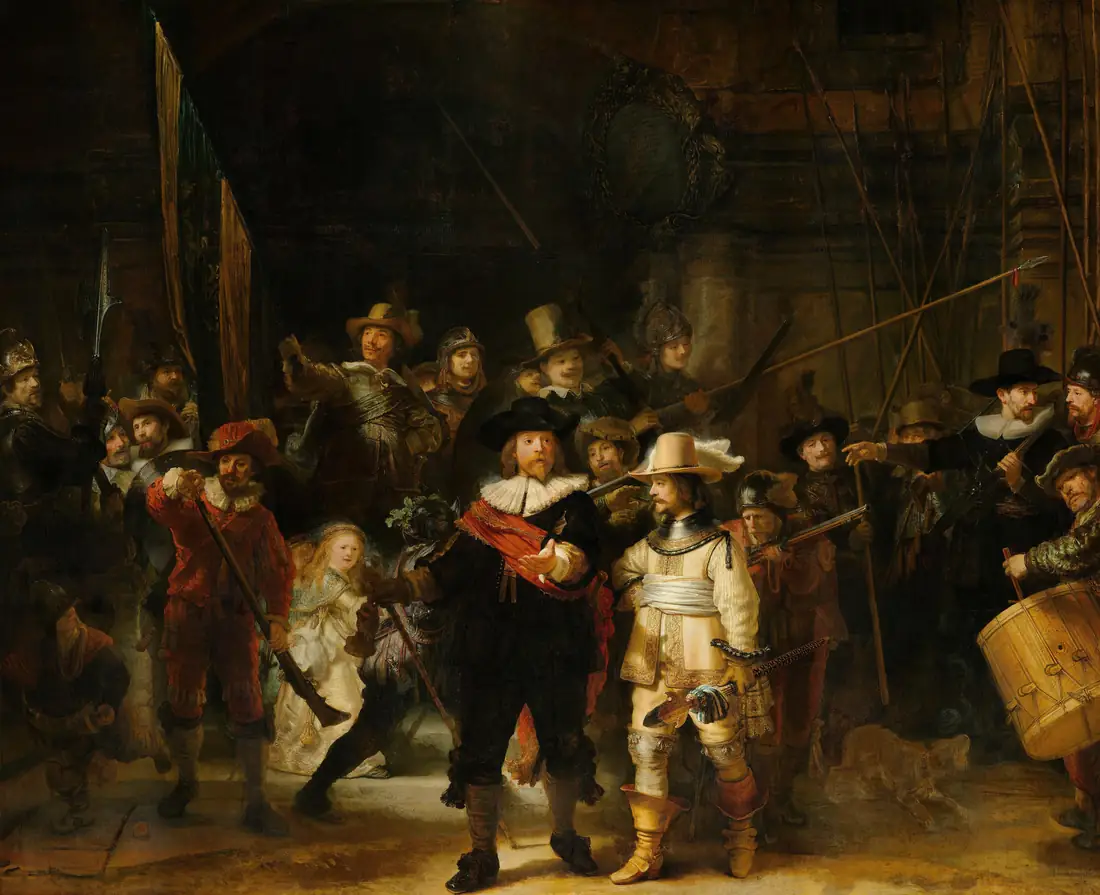
伦勃朗《夜巡》

夜巡The Night WatchDe Nachtwacht

伦勃朗 Rembrandt van Rijn
1642 年 · 布面油画 · 379.5 × 453.5 cm
阿姆斯特丹,荷兰国家博物馆

Rembrandt van Rijn
1642 · Oil on canvas · 379.5 × 453.5 cm
Rijksmuseum, Amsterdam

这是阿姆斯特丹一支火枪手民兵队订制的集体像。别人的集体像都是排排坐,伦勃朗却把它画成了一支正在出发的队伍:有人装弹,有人敲鼓,有人举旗,光在人群里跳跃。

This is a group portrait ordered by an Amsterdam militia company of musketeers. Other group portraits lined people up in rows; Rembrandt painted a company setting out. Someone loads a gun, someone beats a drum, someone raises the banner, and light leaps through the crowd.

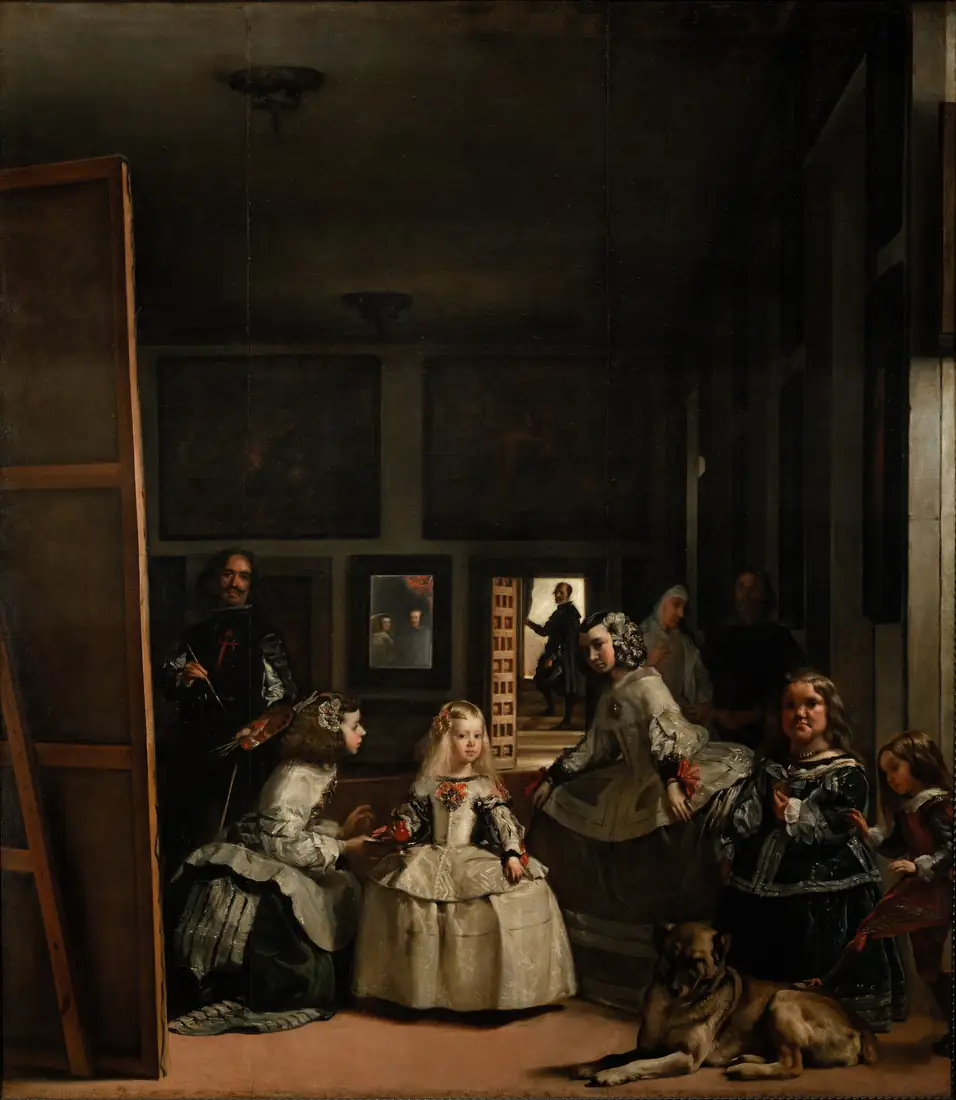
迭戈·委拉斯开兹《宫娥》

宫娥Las MeninasLas Meninas

迭戈·委拉斯开兹 Diego Velázquez
1656 年 · 布面油画 · 318 × 276 cm
马德里,普拉多博物馆

Diego Velázquez
1656 · Oil on canvas · 318 × 276 cm
Museo del Prado, Madrid

西班牙宫廷画家委拉斯开兹画下了一个“日常瞬间”:5 岁的小公主来看他画画。可这幅画越看越像一个关于“看”的谜题:谁在画谁?谁在看谁?

The Spanish court painter Velázquez recorded an everyday moment: the five-year-old princess comes to watch him paint. The longer you look, the more it turns into a puzzle about looking: who is painting whom, and who is looking at whom?

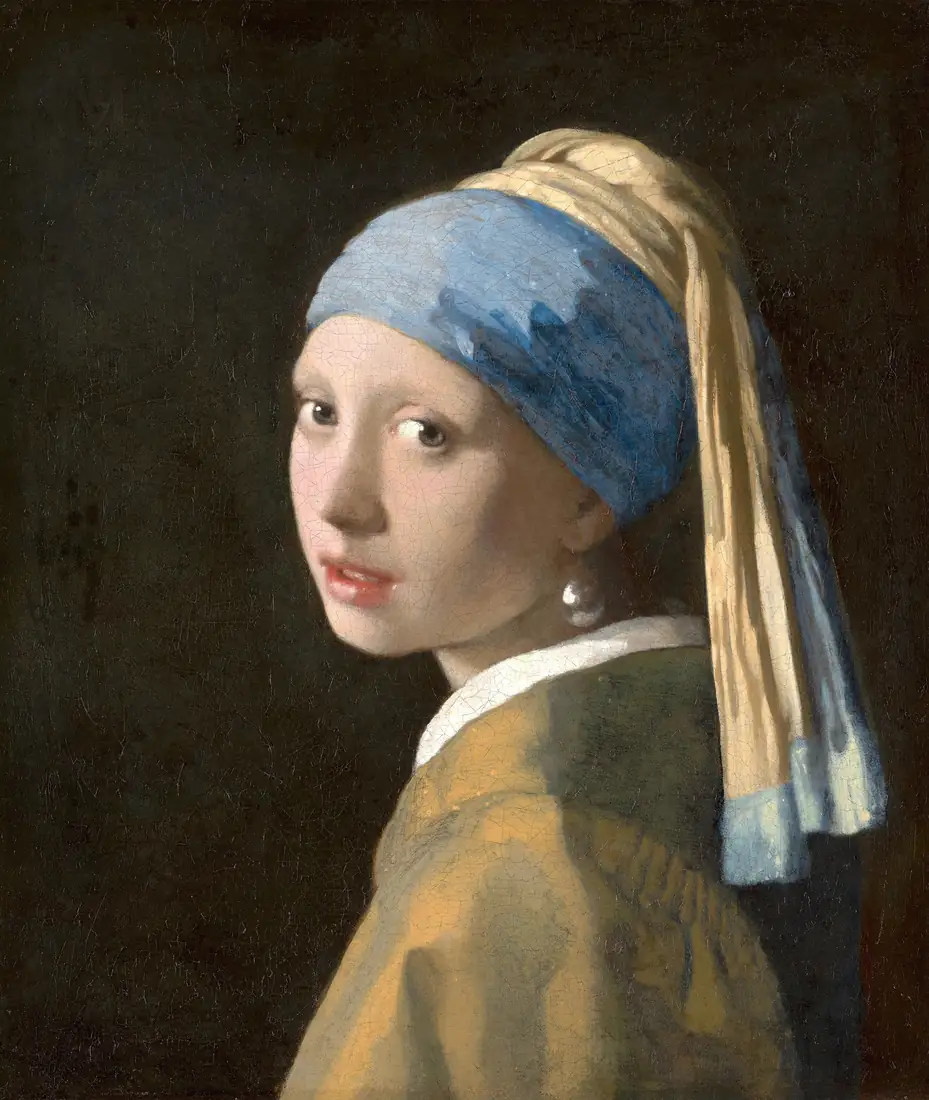
约翰内斯·维米尔《戴珍珠耳环的少女》

戴珍珠耳环的少女Girl with a Pearl EarringMeisje met de parel

约翰内斯·维米尔 Johannes Vermeer
约 1665 年 · 布面油画 · 44.5 × 39 cm
海牙,莫瑞泰斯皇家美术馆

Johannes Vermeer
c. 1665 · Oil on canvas · 44.5 × 39 cm
Mauritshuis, The Hague

维米尔一生只留下三十多幅画,几乎都是代尔夫特安静的室内。这一幅尤其特别:没有房间,没有故事,只有一个回头的瞬间。

Vermeer left only about thirty-five paintings, nearly all quiet interiors in Delft. This one is especially unusual: no room, no story, just a turn of the head.

第 6 展厅Room 61720–1820巴黎 · 罗马Paris · Rome

甜美与理性Sweetness and Reason

洛可可与新古典主义Rococo & NeoclassicismRococo & Neoclassicism

路易十四死后,法国贵族从凡尔赛的宏大仪式里溜回巴黎的私人沙龙。艺术变得轻盈、私密、粉嫩:秋千、调情、林间野餐,这就是洛可可。

半个世纪后,庞贝古城的发掘、启蒙思想和人们对贵族奢靡的厌倦,让画家转身拥抱古罗马的简朴、克制与美德:新古典主义登场。

After Louis XIV died, the French nobility slipped away from the grand rituals of Versailles to private salons in Paris. Art turned light, intimate and pastel: swings, flirtation, picnics in the woods. This was the Rococo.

Half a century later, the excavation of Pompeii, Enlightenment ideas and weariness with aristocratic excess turned painters toward the simplicity, restraint and virtue of ancient Rome. Neoclassicism had arrived.

  • 洛可可Rococo

    源自法语 rocaille(贝壳状的岩石装饰),以 S 形曲线、粉彩色调和享乐题材著称。

  • Rococo

    From the French rocaille, shell-like rockwork ornament. Known for S-curves, pastel tones and pleasure-seeking subjects.

  • 新古典主义Neoclassicism

    回到古希腊罗马:清晰的线条、克制的情感、宣扬美德的题材。

  • Neoclassicism

    A return to Greece and Rome: clear outlines, restrained feeling and subjects that preach virtue.

  • 沙龙Salon

    巴黎的官方美术展览。能不能入选、挂在哪里,几乎决定一个画家的前途。

  • The Salon

    The official art exhibition in Paris. Getting in, and where your picture hung, could decide a painter’s career.

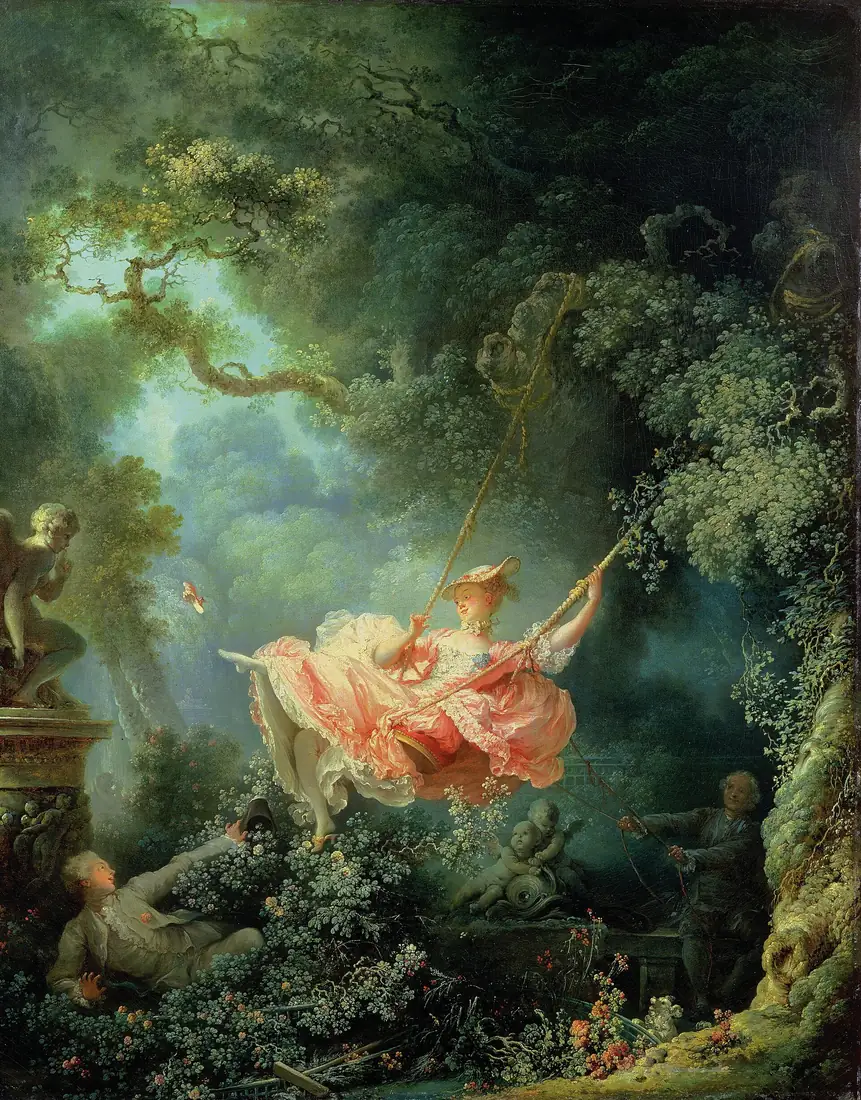
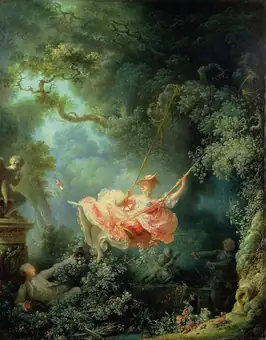
让-奥诺雷·弗拉戈纳尔《秋千》

秋千The SwingLes Hasards heureux de l’escarpolette

让-奥诺雷·弗拉戈纳尔 Jean-Honoré Fragonard
约 1767 年 · 布面油画 · 81 × 64.2 cm
伦敦,华莱士收藏馆

Jean-Honoré Fragonard
c. 1767 · Oil on canvas · 81 × 64.2 cm
Wallace Collection, London

原名直译是《秋千的美妙意外》。这大概是最有名的洛可可绘画:一个关于偷看、调情和秘密的瞬间。

Its original title means “The Happy Accidents of the Swing”. It is probably the most famous Rococo painting: a moment of peeping, flirtation and secrets.

对比滑块

Compare

相隔 42 年的两个法国

Two Frances, 42 years apart

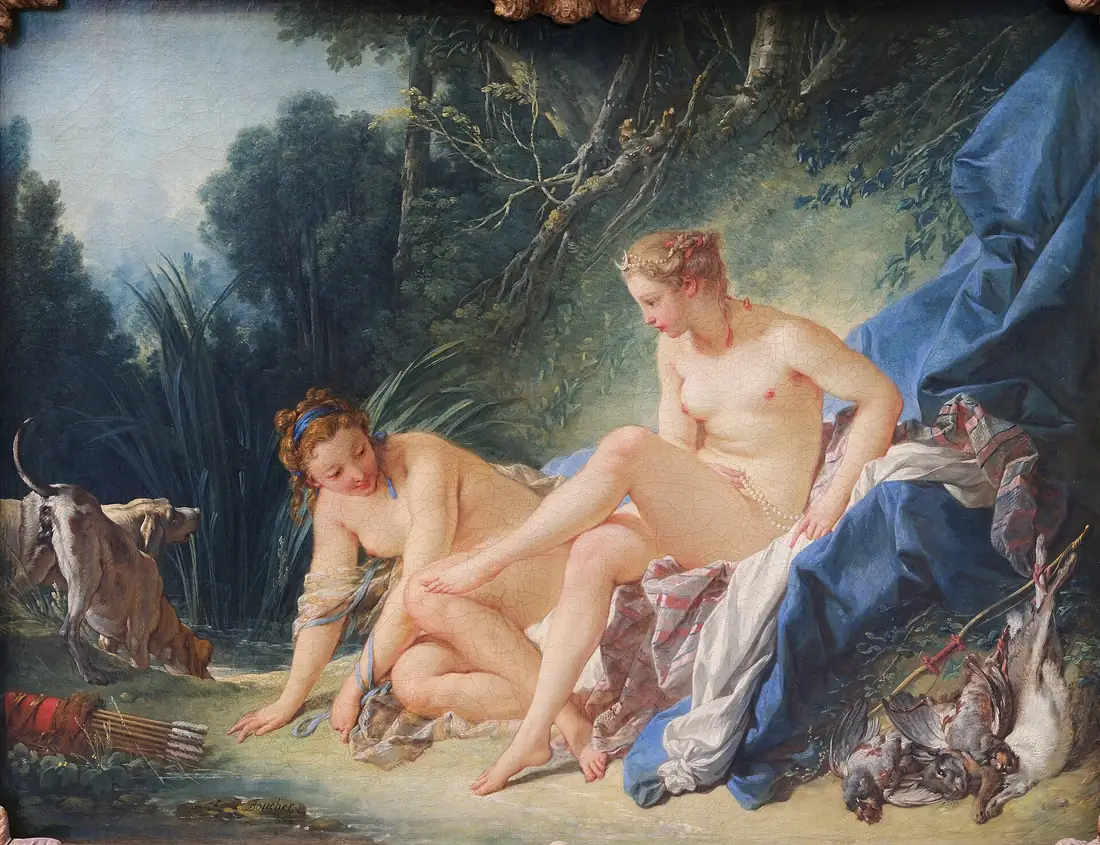
弗朗索瓦·布歇《沐浴后的狄安娜》
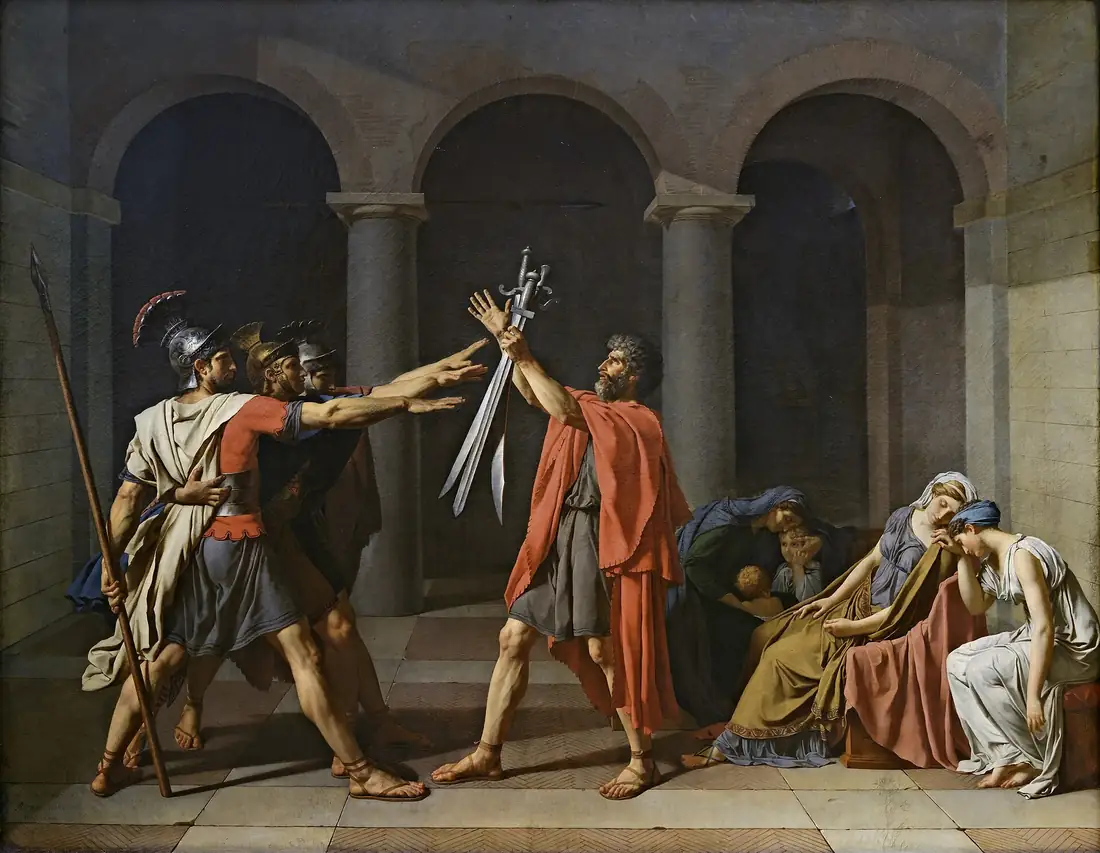
雅克-路易·大卫《荷拉斯兄弟之誓》
布歇 · 1742François Boucher · 1742 大卫 · 1784Jacques-Louis David · 1784

布歇《沐浴后的狄安娜》1742 · 巴黎,卢浮宫

  • 柔软的曲线,珍珠般的肌肤,粉蓝与奶油色。
  • 女神在休息,画面只为取悦眼睛。
  • 实际只有 57 × 73 厘米,是挂在私人客厅里的小画。

François Boucher, Diana Leaving Her Bath1742 · Louvre, Paris

  • Soft curves, pearly skin, powder blue and cream.
  • The goddess is resting; the picture exists only to please the eye.
  • It is just 57 × 73 cm, a small picture for a private drawing room.

大卫《荷拉斯兄弟之誓》1784 · 巴黎,卢浮宫

  • 直线、直角,三道拱门把画面切成三份。
  • 男人们的手臂和剑像钢筋一样笔直,要求你为国家牺牲。
  • 高 3.3 米、宽 4.25 米,是一份给公众看的宣言。

Jacques-Louis David, Oath of the Horatii1784 · Louvre, Paris

  • Straight lines and right angles; three arches cut the picture into three.
  • The men’s arms and swords are as straight as steel bars, demanding that you die for your country.
  • It is 3.3 m high and 4.25 m wide, a manifesto made for the public.

滑块把两幅画缩放到了同样大小。按面积算,大卫这幅是布歇那幅的将近 34 倍。

The slider shows both paintings at the same size. By area, David’s canvas is almost 34 times larger than Boucher’s.

雅克-路易·大卫《荷拉斯兄弟之誓》

荷拉斯兄弟之誓Oath of the HoratiiLe Serment des Horaces

雅克-路易·大卫 Jacques-Louis David
1784 年 · 布面油画 · 330 × 425 cm
巴黎,卢浮宫

Jacques-Louis David
1784 · Oil on canvas · 330 × 425 cm
Louvre, Paris

故事来自古罗马:罗马与邻城交战,双方各派三兄弟决斗定胜负。大卫画的是出征前的宣誓。它在 1785 年的沙龙上引起轰动,四年后法国大革命爆发。

The story comes from ancient Rome: at war with a neighbouring city, each side sent three brothers to settle it in combat. David painted the oath before they leave. It caused a sensation at the Salon of 1785; four years later the French Revolution broke out.

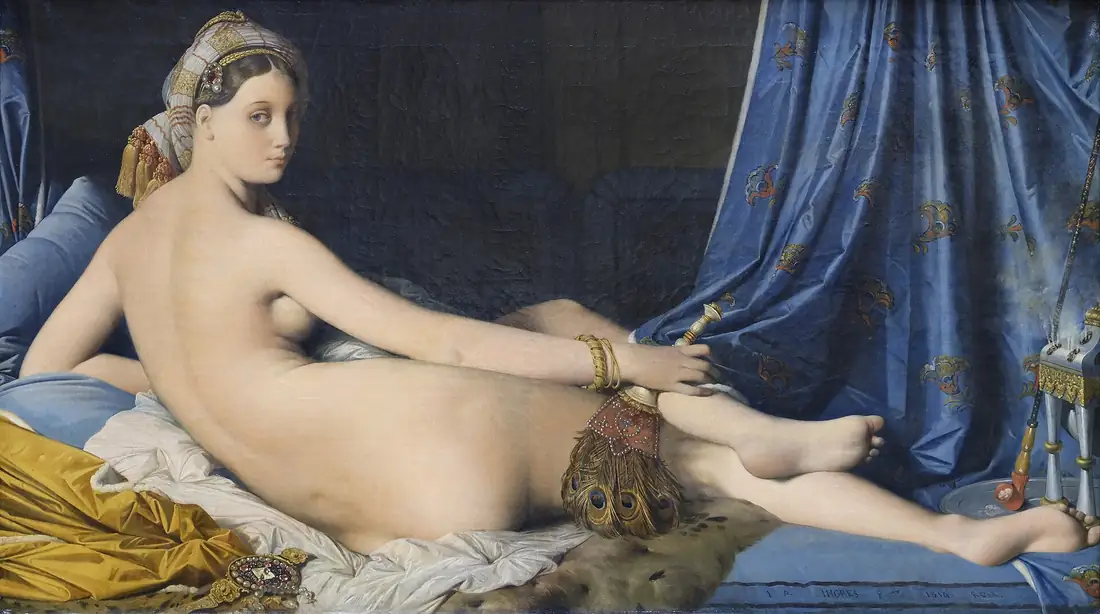
让-奥古斯特-多米尼克·安格尔《大宫女》

大宫女Grande OdalisqueLa Grande Odalisque

让-奥古斯特-多米尼克·安格尔 Jean-Auguste-Dominique Ingres
1814 年 · 布面油画 · 91 × 162 cm
巴黎,卢浮宫

Jean-Auguste-Dominique Ingres
1814 · Oil on canvas · 91 × 162 cm
Louvre, Paris

安格尔是新古典主义最后的旗手,一生信奉线条至上,说过“素描是艺术的诚实”。可在这幅画里,他为了线条的优美,故意牺牲了解剖的准确。

Ingres was the last standard-bearer of Neoclassicism and believed all his life that line came first; he called drawing “the probity of art”. Yet here he deliberately sacrificed anatomical accuracy for the beauty of a line.

第 7 展厅Room 71800–1850马德里 · 德累斯顿 · 伦敦 · 巴黎Madrid · Dresden · London · Paris

激情Passion

浪漫主义RomanticismRomanticism

拿破仑战争、工业革命、不断膨胀的城市,19 世纪初的欧洲剧烈震荡。浪漫主义画家不再相信理性能解释一切。

他们画风暴、废墟、战争、孤独的人和无边的自然。重要的不是“正确”,而是“感受”。

The Napoleonic Wars, the Industrial Revolution and swelling cities shook Europe in the early 19th century. Romantic painters no longer believed that reason could explain everything.

They painted storms, ruins, war, lonely figures and boundless nature. What mattered was not being correct but feeling.

  • 崇高The Sublime

    面对狂风、雪山、大海时那种夹杂着恐惧的震撼,一种比“美”更强烈的感受。

  • The Sublime

    The awe, mixed with fear, that you feel before gales, snowy peaks or the sea. Something stronger than beauty.

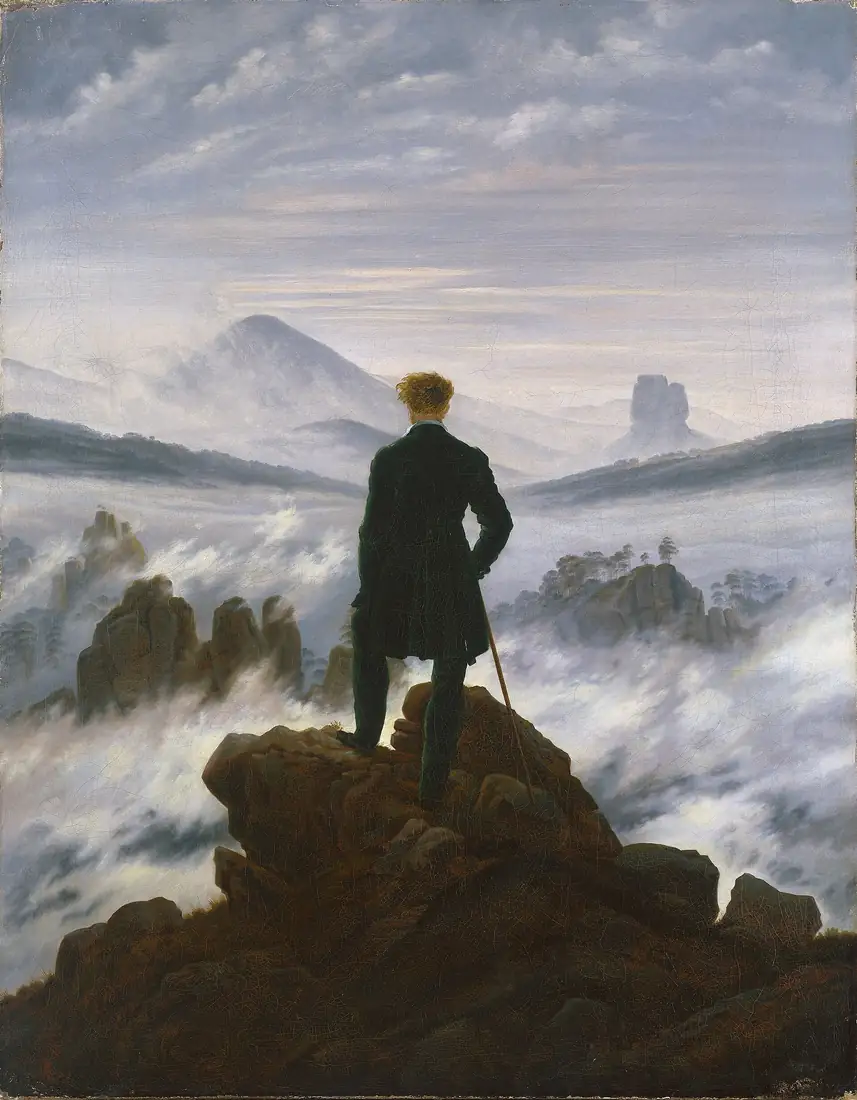
  • 背影人物Rückenfigur

    德语“背影人物”。画中人背对我们,邀请我们站到他的位置去看。

  • Rückenfigur

    German for “back figure”. A figure seen from behind invites us to stand in their place and look.

  • 色彩与线条Colour vs. line

    德拉克洛瓦与安格尔之争:画面应该由色彩的激情驱动,还是由线条的秩序统治?

  • Colour vs. line

    Delacroix against Ingres: should a picture be driven by the passion of colour, or ruled by the order of line?

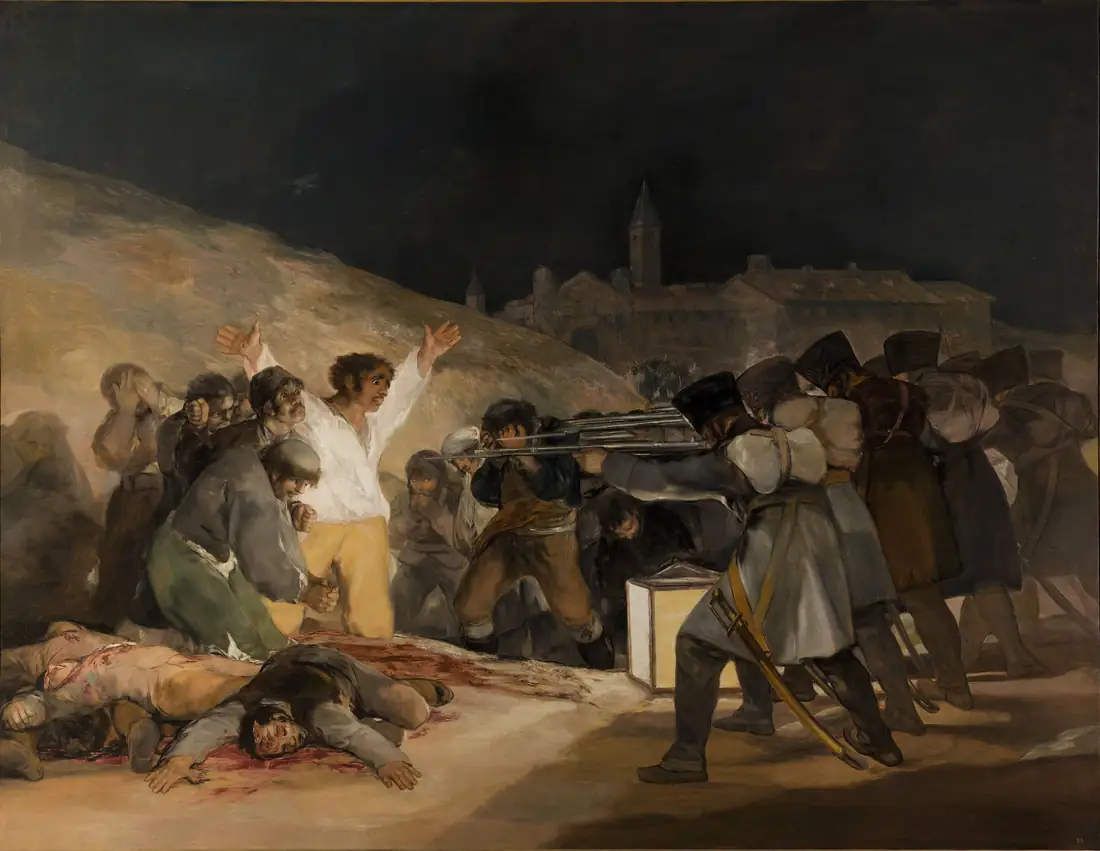
弗朗西斯科·戈雅《1808 年 5 月 3 日》

1808 年 5 月 3 日The Third of May 1808El tres de mayo de 1808 en Madrid

弗朗西斯科·戈雅 Francisco de Goya
1814 年 · 布面油画 · 268 × 347 cm
马德里,普拉多博物馆

Francisco de Goya
1814 · Oil on canvas · 268 × 347 cm
Museo del Prado, Madrid

1808 年 5 月 2 日,马德里市民起义反抗拿破仑的军队;第二天凌晨,法军枪决了大批平民。六年后,戈雅画下了这一幕。它是最早一批没有英雄、没有荣耀、只有受害者的战争画,马奈和毕加索后来都向它致敬。

On 2 May 1808 the people of Madrid rose against Napoleon’s army; before dawn the next day French troops shot large numbers of civilians. Six years later Goya painted the scene. It is one of the first war paintings with no heroes and no glory, only victims; Manet and Picasso later paid it homage.

卡斯帕·大卫·弗里德里希《雾海上的旅人》

雾海上的旅人Wanderer above the Sea of FogDer Wanderer über dem Nebelmeer

卡斯帕·大卫·弗里德里希 Caspar David Friedrich
约 1818 年 · 布面油画 · 94.8 × 74.8 cm
汉堡美术馆

Caspar David Friedrich
c. 1818 · Oil on canvas · 94.8 × 74.8 cm
Hamburger Kunsthalle, Hamburg

这可能是浪漫主义最有名的一幅画。一个人站在山巅,面对翻涌的雾海。我们看不见他的表情,只能和他一起看。

This may be the most famous Romantic painting. A man stands on a summit facing a churning sea of fog. We can’t see his face; we can only look with him.

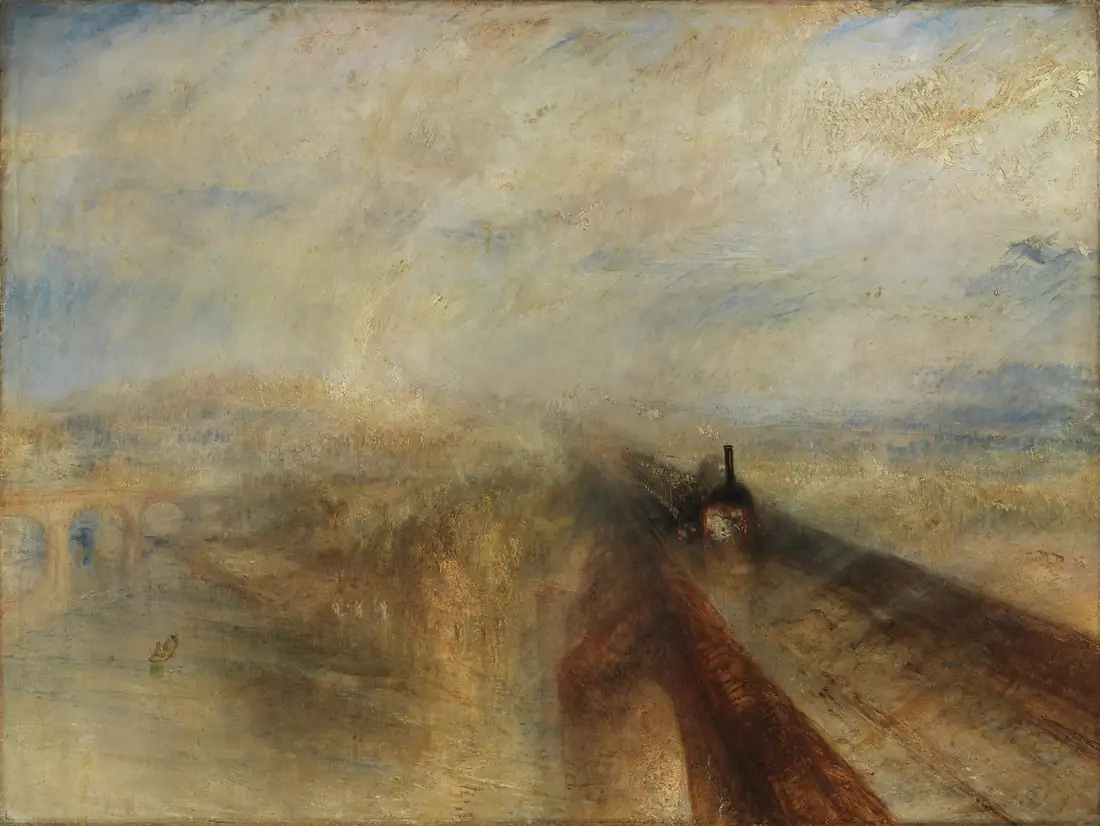
J. M. W. 透纳《雨、蒸汽和速度:西部大铁路》

雨、蒸汽和速度:西部大铁路Rain, Steam and Speed – The Great Western RailwayRain, Steam and Speed – The Great Western Railway

J. M. W. 透纳 J. M. W. Turner
1844 年 · 布面油画 · 91 × 121.8 cm
伦敦,英国国家美术馆

J. M. W. Turner
1844 · Oil on canvas · 91 × 121.8 cm
National Gallery, London

火车在当时是最新的科技,也代表一种前所未有的速度。透纳没有把火车画清楚,而是画出了速度本身:雨、雾、蒸汽和光融成一片。

The train was the newest technology of the day and stood for a speed no one had known before. Turner did not paint the train clearly; he painted speed itself, with rain, mist, steam and light melting together.

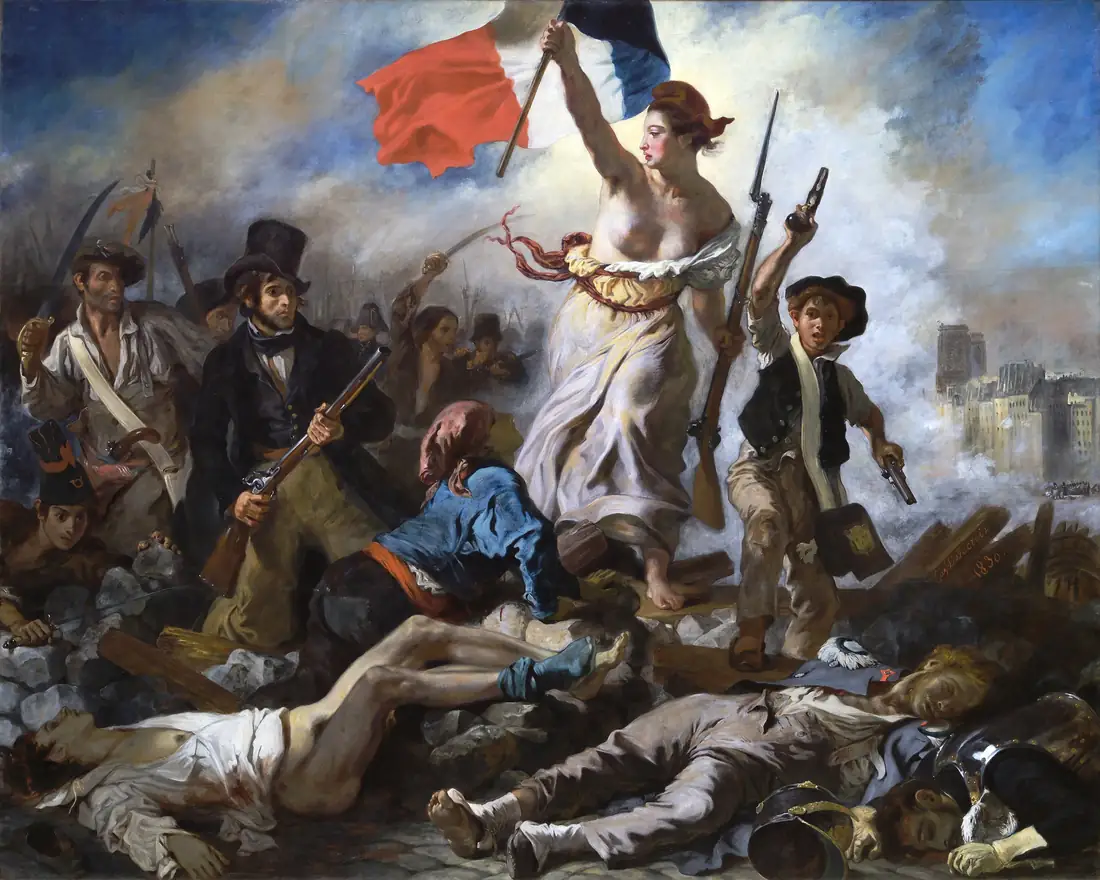
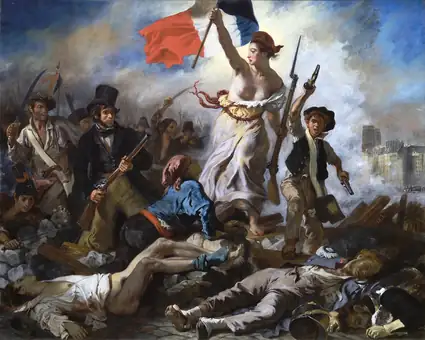
欧仁·德拉克洛瓦《自由引导人民》

自由引导人民Liberty Leading the PeopleLa Liberté guidant le peuple

欧仁·德拉克洛瓦 Eugène Delacroix
1830 年 · 布面油画 · 260 × 325 cm
巴黎,卢浮宫

Eugène Delacroix
1830 · Oil on canvas · 260 × 325 cm
Louvre, Paris

1830 年 7 月,巴黎市民用三天巷战推翻了国王查理十世。德拉克洛瓦在给哥哥的信里写道:我虽然没能为祖国而战,至少可以为她作画。

In July 1830 Parisians overthrew King Charles X in three days of street fighting. Delacroix wrote to his brother that if he had not fought for his country, at least he would paint for her.

第 8 展厅Room 81848–1870巴黎 · 奥尔南 · 巴比松Paris · Ornans · Barbizon

直视Eye to Eye

现实主义与马奈Realism & ManetRealism & Manet

1839 年照相术诞生,1848 年欧洲革命失败。画家们开始追问:神话和英雄还值得画吗?库尔贝说:“给我看一个天使,我就画一个。”

现实主义把农民、工人、乡村葬礼放上了过去只属于历史画的巨大画布。接着,马奈把这种“直视”推向了更挑衅的方向。

Photography was born in 1839, and the revolutions of 1848 failed. Painters began to ask whether myths and heroes were still worth painting. Courbet said: “Show me an angel and I will paint one.”

Realism put peasants, workers and a village funeral onto huge canvases that had belonged to history painting. Then Manet pushed this direct look in a more provocative direction.

  • 现实主义Realism

    只画亲眼所见的当代生活,拒绝美化和理想化。

  • Realism

    Paint only the contemporary life you have seen with your own eyes, without prettifying or idealising.

  • 历史画History painting

    学院体系里地位最高的题材:神话、宗教、历史大事件。尺寸越大,越显隆重。

  • History painting

    The highest genre in the academic system: myth, religion and great events. The bigger the canvas, the grander.

  • 落选者沙龙Salon des Refusés

    1863 年官方沙龙拒收了约三千件作品,拿破仑三世下令另办一个展览,让公众自己评判。

  • Salon des Refusés

    In 1863 the official Salon rejected about 3,000 works. Napoleon III ordered a separate show so the public could judge for itself.

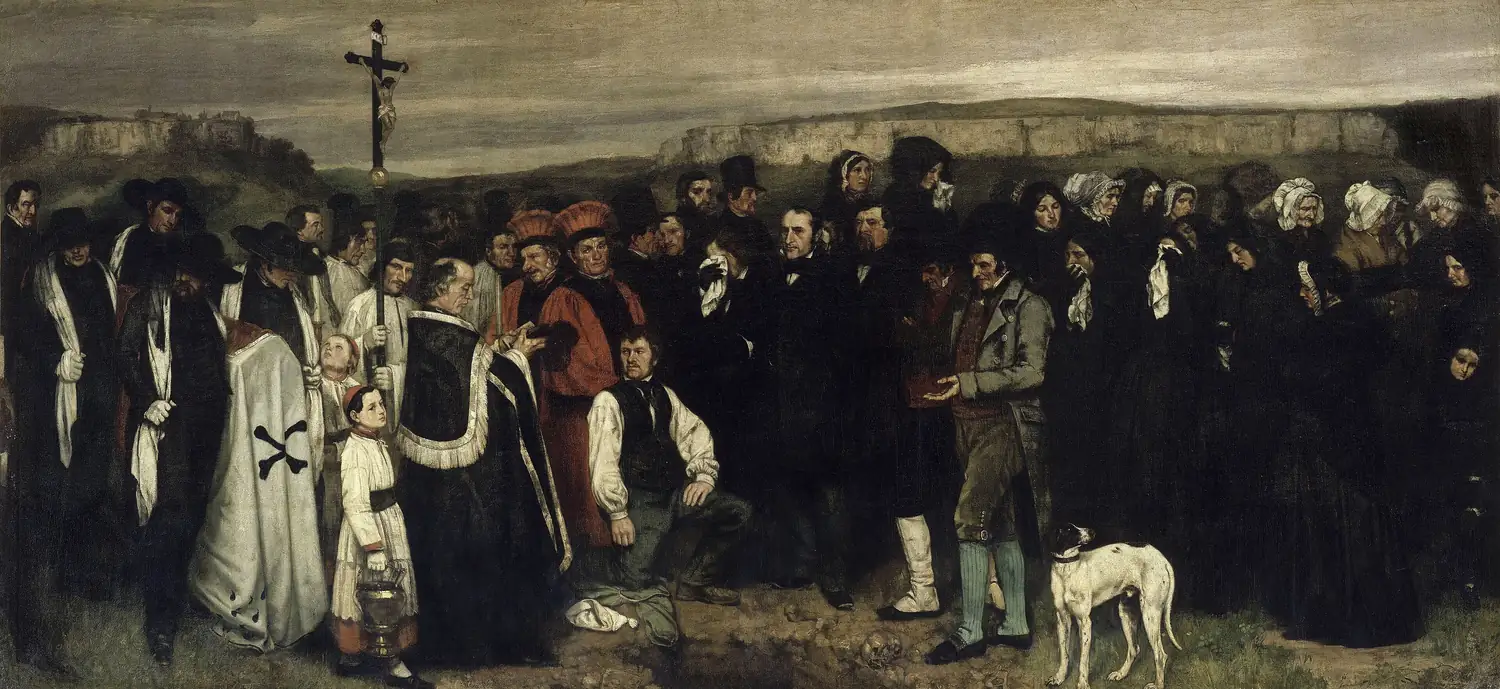
古斯塔夫·库尔贝《奥尔南的葬礼》

奥尔南的葬礼A Burial at OrnansUn enterrement à Ornans

古斯塔夫·库尔贝 Gustave Courbet
1849–1850 年 · 布面油画 · 315 × 668 cm
巴黎,奥赛博物馆

Gustave Courbet
1849–1850 · Oil on canvas · 315 × 668 cm
Musée d’Orsay, Paris

将近 7 米宽的画布,过去只留给神话、圣经和帝王。库尔贝却用它画了家乡小镇一场普通人的葬礼。评论家被激怒了:这么平凡的人,凭什么占据这么大的画面?

A canvas almost seven metres wide had been reserved for myth, the Bible and kings. Courbet used it for an ordinary funeral in his home town. The critics were outraged: how could such ordinary people take up such a huge picture?

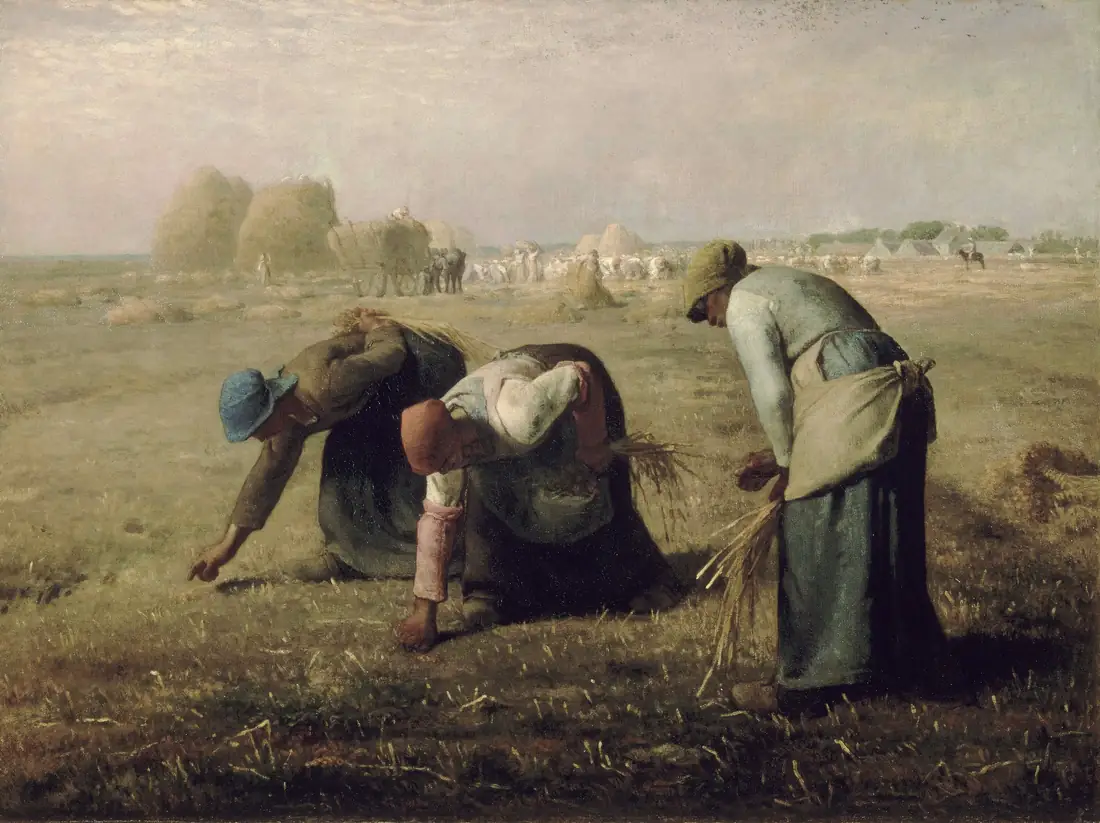
让-弗朗索瓦·米勒《拾穗者》

拾穗者The GleanersDes glaneuses

让-弗朗索瓦·米勒 Jean-François Millet
1857 年 · 布面油画 · 83.5 × 110 cm
巴黎,奥赛博物馆

Jean-François Millet
1857 · Oil on canvas · 83.5 × 110 cm
Musée d’Orsay, Paris

米勒住在巴黎郊外的巴比松村,一辈子都在画农民。这幅画在沙龙展出时,让一些评论家很紧张:他们担心它会煽动穷人。

Millet lived in the village of Barbizon outside Paris and painted peasants all his life. When this was shown at the Salon, some critics grew nervous that it might stir up the poor.

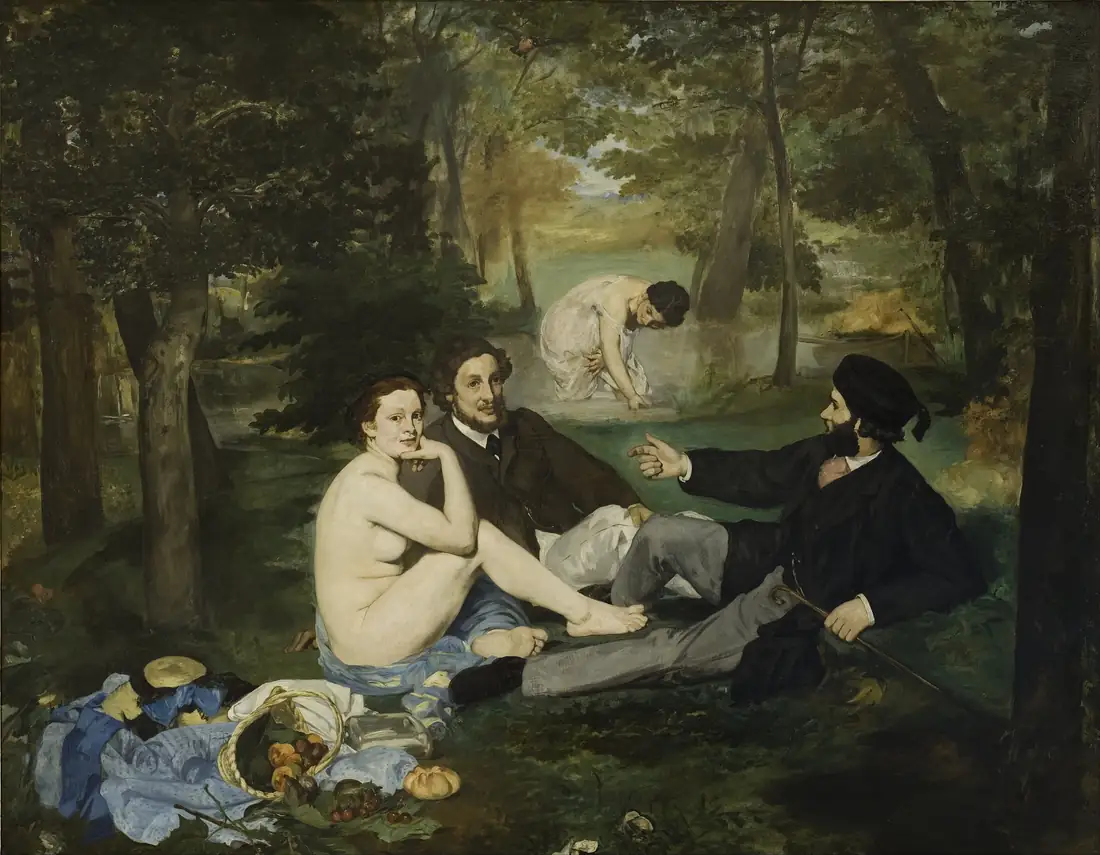
爱德华·马奈《草地上的午餐》

草地上的午餐Luncheon on the GrassLe Déjeuner sur l’herbe

爱德华·马奈 Édouard Manet
1863 年 · 布面油画 · 208 × 264.5 cm
巴黎,奥赛博物馆

Édouard Manet
1863 · Oil on canvas · 208 × 264.5 cm
Musée d’Orsay, Paris

它在 1863 年被官方沙龙拒收,到了落选者沙龙又成了最大的丑闻。让人愤怒的不是裸体本身,而是她没有任何神话借口:她就坐在两个穿着时髦西装的巴黎男人中间。

It was rejected by the official Salon in 1863 and became the biggest scandal of the Salon des Refusés. What angered people was not nudity itself but that she had no mythological excuse: she sits between two Parisian men in fashionable suits.

对比滑块

Compare

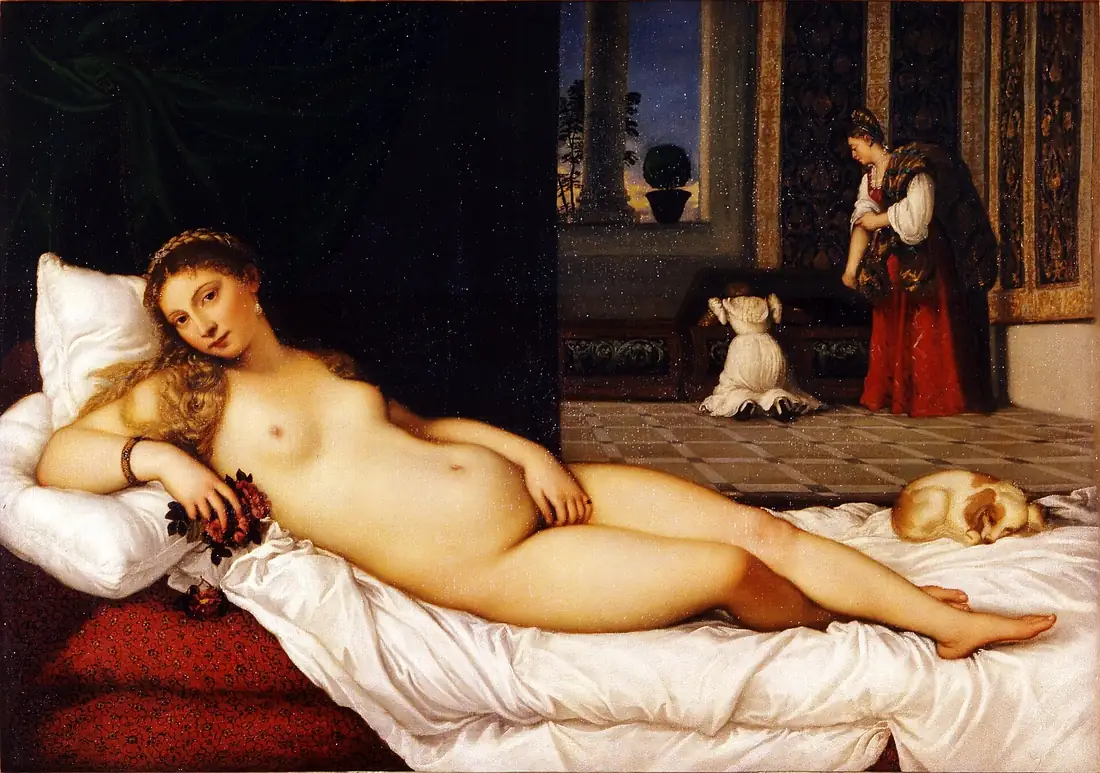
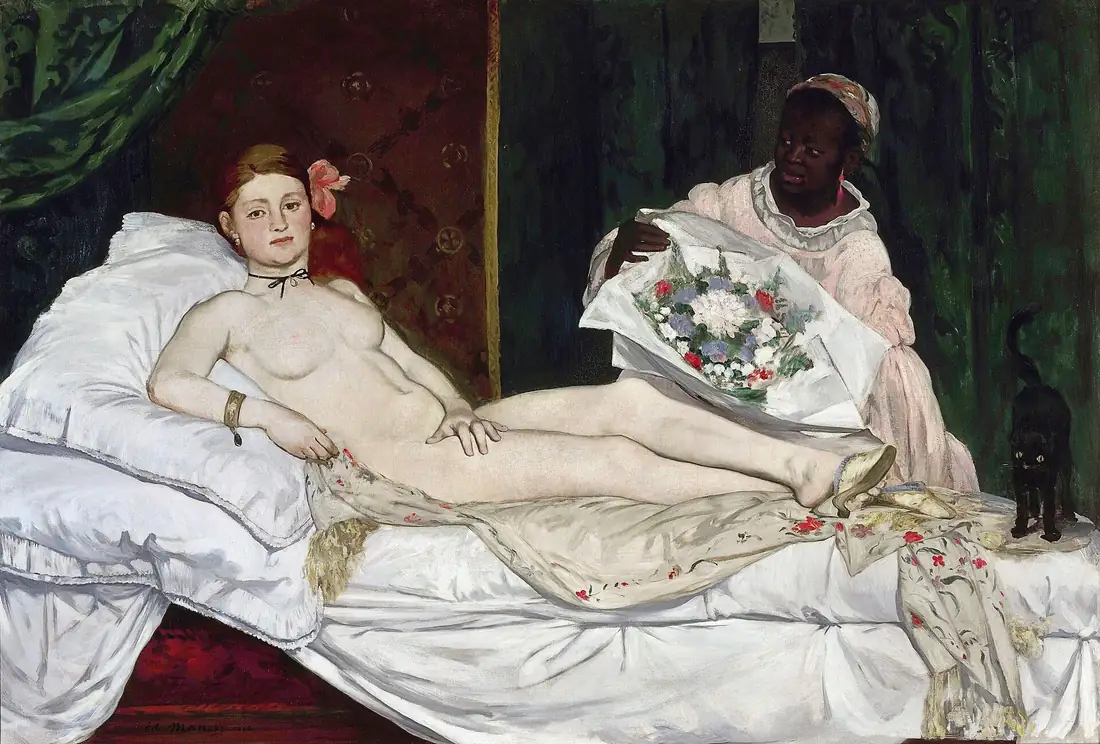
同一个姿势,相隔 325 年

The same pose, 325 years apart

提香《乌尔比诺的维纳斯》
爱德华·马奈《奥林匹亚》
提香 · 1538Titian · 1538 马奈 · 1863Édouard Manet · 1863

提香《乌尔比诺的维纳斯》1538 · 佛罗伦萨,乌菲兹美术馆

  • 女神(也可能是一位新娘)温柔地望着我们,肌肤温暖柔和。
  • 脚边睡着一只象征忠诚的小狗。
  • 背景里女仆在翻找嫁妆箱:一个私密、理想化的世界。

Titian, Venus of Urbino1538 · Uffizi, Florence

  • The goddess (or perhaps a bride) looks at us gently, her skin warm and soft.
  • A little dog, a symbol of fidelity, sleeps at her feet.
  • In the background maids search a wedding chest: a private, idealised world.

马奈《奥林匹亚》1863 · 巴黎,奥赛博物馆

  • 同样的姿势、同样的构图,但神话的外衣被扒掉了。
  • 小狗换成了竖起尾巴的黑猫,女仆捧来客人送的花。
  • 她冷静地直视我们,像在打量一位来客。

Édouard Manet, Olympia1863 · Musée d’Orsay, Paris

  • The same pose and composition, with the mythological costume stripped away.
  • The dog becomes a black cat with its tail up, and the maid brings flowers from a client.
  • She looks at us coolly, as if sizing up a visitor.

马奈年轻时去意大利,在乌菲兹临摹过这幅提香。

As a young man travelling in Italy, Manet copied this Titian in the Uffizi.

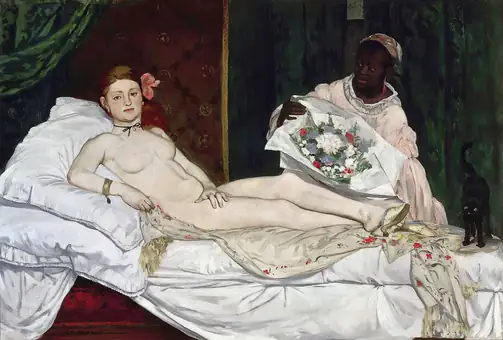
爱德华·马奈《奥林匹亚》

奥林匹亚OlympiaOlympia

爱德华·马奈 Édouard Manet
1863 年(1865 年展出) · 布面油画 · 130.5 × 190 cm
巴黎,奥赛博物馆

Édouard Manet
1863 (shown 1865) · Oil on canvas · 130.5 × 190 cm
Musée d’Orsay, Paris

1865 年的沙龙上,愤怒的观众想用雨伞戳它,馆方只好派警卫看守,后来又把它挂到了高处。

At the Salon of 1865, angry visitors wanted to poke it with their umbrellas. The organisers posted guards and later rehung it high up on the wall.

第 9 展厅Room 91869–1886巴黎 · 塞纳河畔 · 勒阿弗尔Paris · the Seine · Le Havre

光Light

印象派ImpressionismImpressionism

1874 年,一群屡遭沙龙拒绝的画家,在摄影师纳达尔的旧工作室里自己办了一场展览。评论家勒鲁瓦看到莫奈的《日出·印象》,挖苦地把整群人叫作“印象派”。

他们把画架搬到户外,用快速、破碎的笔触追赶稍纵即逝的光。1841 年发明的锡管颜料,让这一切成为可能。

In 1874 a group of painters who had been turned down by the Salon again and again put on their own exhibition in the photographer Nadar’s former studio. Seeing Monet’s Impression, Sunrise, the critic Louis Leroy mockingly called the whole group “Impressionists”.

They took their easels outdoors and chased fleeting light with quick, broken brushstrokes. Paint in tin tubes, invented in 1841, made this possible.

  • 外光画法En plein air

    直接在户外对景写生,追着光和天气作画。

  • En plein air

    Painting outdoors, directly from the motif, chasing the light and the weather.

  • 色彩分割Broken colour

    不在调色板上调匀,而是把纯色并排放在画布上,让眼睛自己去混合。

  • Broken colour

    Instead of mixing on the palette, pure colours sit side by side on the canvas and the eye does the mixing.

  • 彩色阴影Coloured shadows

    阴影不是黑或褐,而是带着蓝和紫,因为它被蓝天照亮。

  • Coloured shadows

    Shadows are not black or brown but tinged with blue and violet, because the blue sky lights them.

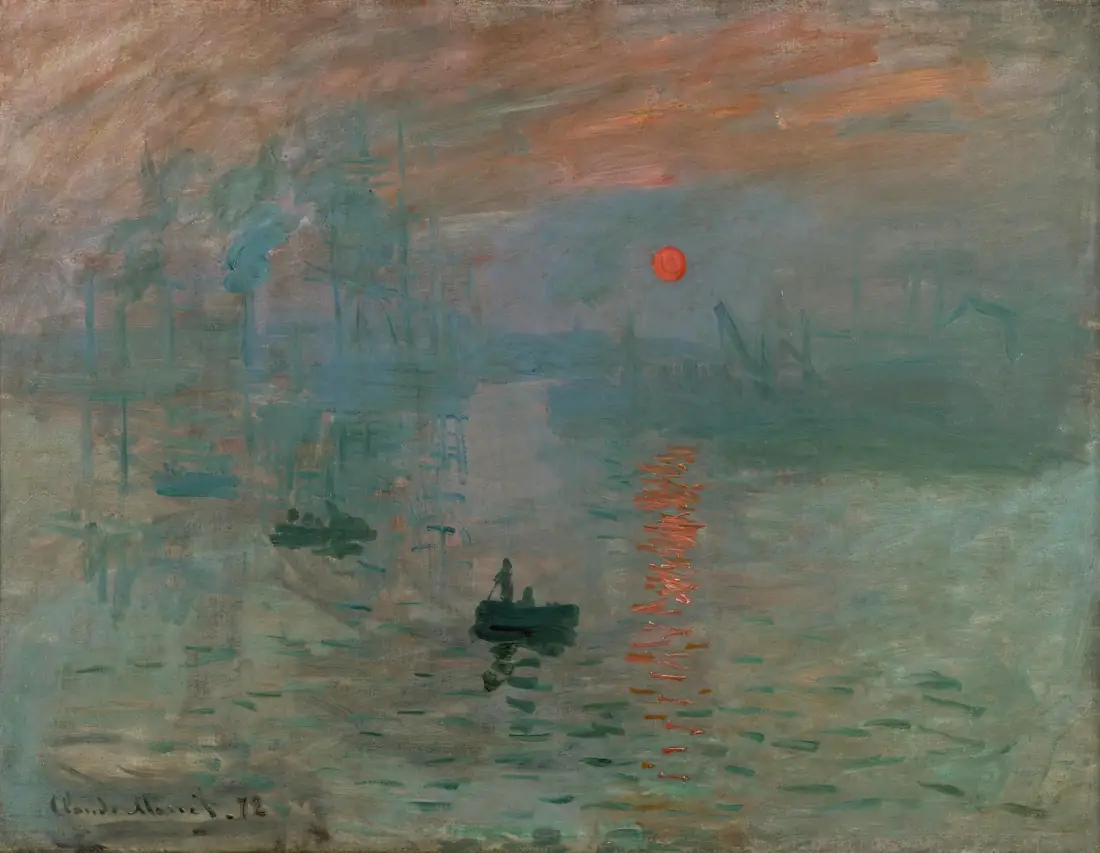
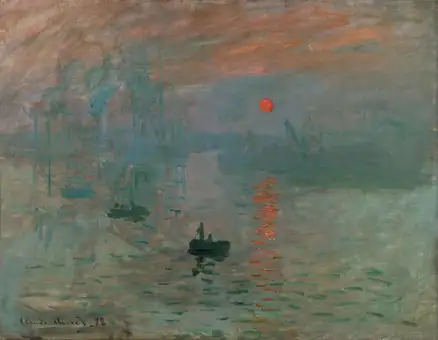
克劳德·莫奈《日出·印象》

日出·印象Impression, SunriseImpression, soleil levant

克劳德·莫奈 Claude Monet
1872 年 · 布面油画 · 48 × 63 cm
巴黎,马摩丹·莫奈美术馆

Claude Monet
1872 · Oil on canvas · 48 × 63 cm
Musée Marmottan Monet, Paris

这是莫奈家乡勒阿弗尔港的清晨。展览目录需要一个标题时,莫奈随口说:“就写‘印象’吧。”这个词后来成了一个时代的名字。

This is dawn over the port of Le Havre, where Monet grew up. When the exhibition catalogue needed a title, Monet said offhand: “Put Impression.” The word went on to name an era.

实验台

Lab

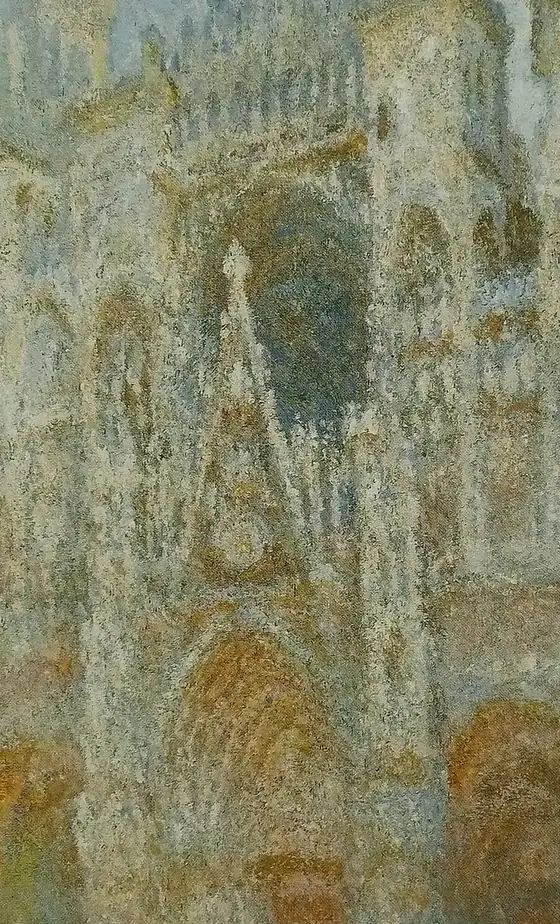
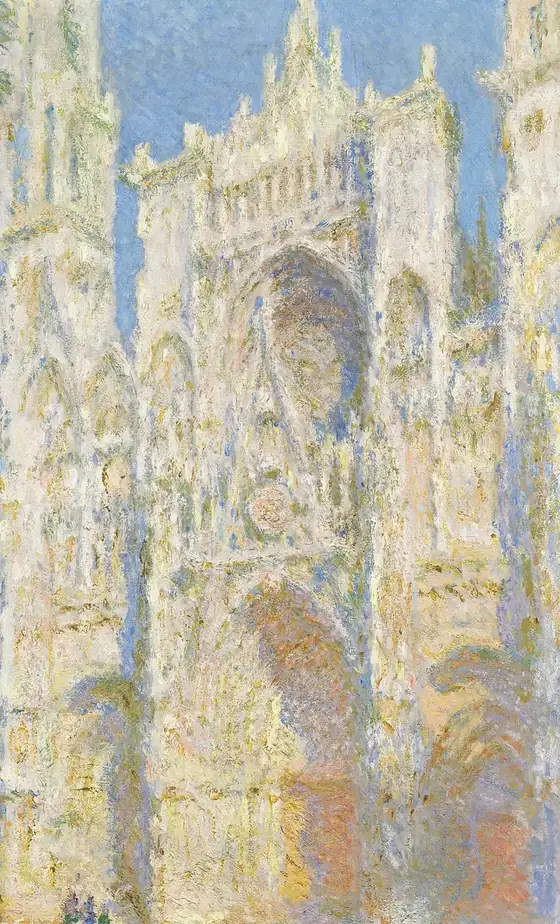
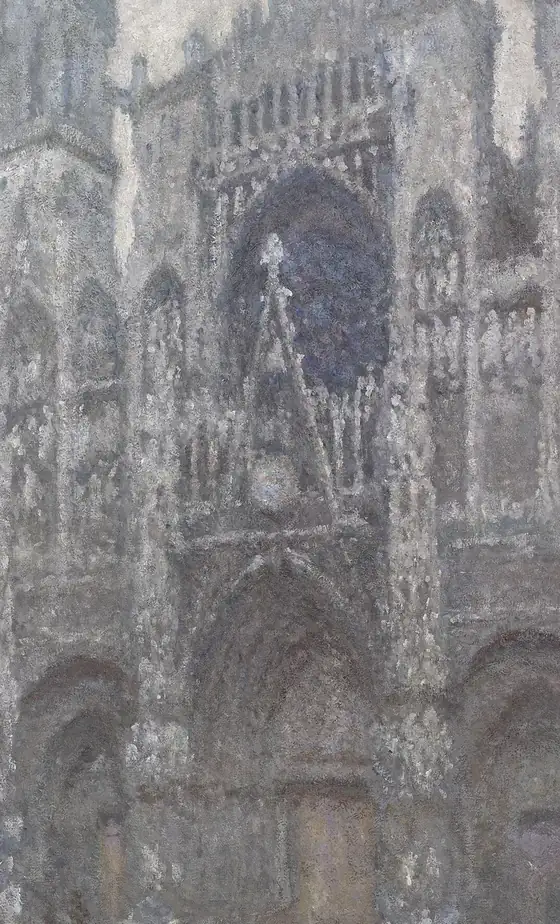
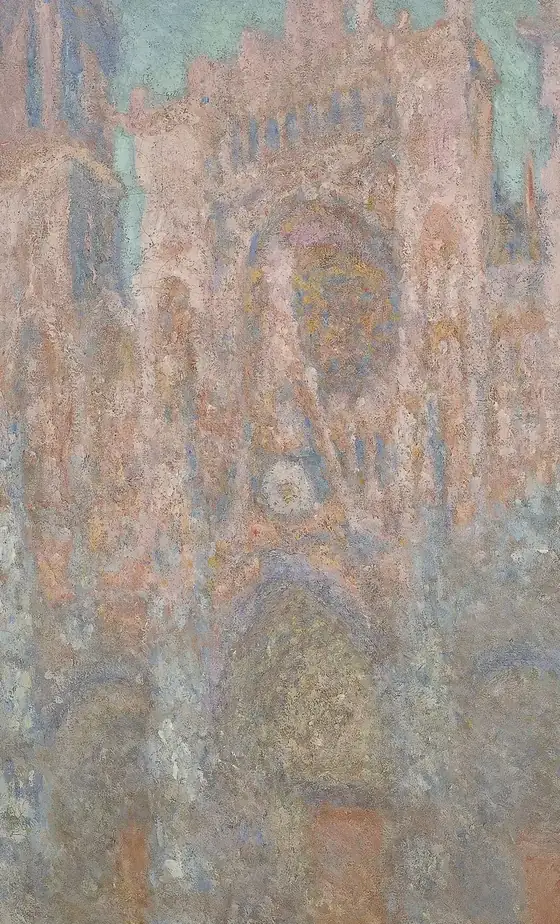
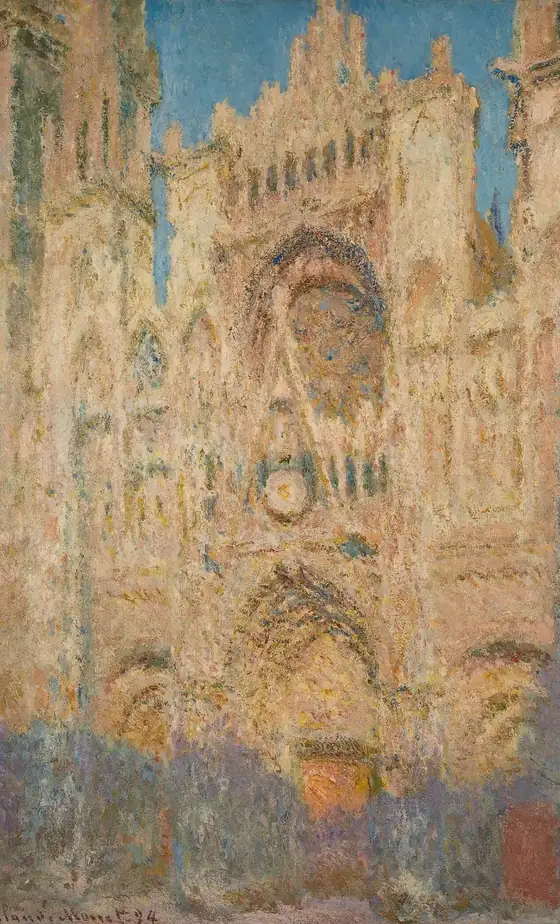
同一座教堂,一天的光

One cathedral, one day of light

拖动滑块,或者点“播放”,看光怎样改写同一个立面。

Drag the slider, or press Play, to watch light rewrite the same façade.

莫奈《鲁昂大教堂》清晨 · 蓝色和谐莫奈《鲁昂大教堂》正午 · 阳光下的西立面莫奈《鲁昂大教堂》阴天 · 灰色的天气莫奈《鲁昂大教堂》午后 · 红色的阳光莫奈《鲁昂大教堂》日暮 · 一天的尽头

1892 和 1893 年的早春,莫奈两次来到鲁昂,在大教堂对面租下房间,从窗口画同一个立面。他同时开着好几张画布,光一变就换一张。1894 年回到吉维尼的画室后,他把三十多幅一一完成,第二年挑出 20 幅在巴黎展出。

他想画的不是教堂,而是教堂与眼睛之间那一层光和空气。这里的五幅分藏在巴黎、华盛顿、贝尔格莱德和莫斯科,按光线从早到晚排列,并对齐了大门的位置。

In the early springs of 1892 and 1893, Monet went twice to Rouen and rented rooms facing the cathedral, painting the same façade from the window. He kept several canvases going at once and switched whenever the light changed. Back in his studio at Giverny in 1894 he finished more than thirty, and the following year showed twenty of them in Paris.

He wanted to paint not the cathedral but the layer of light and air between the cathedral and the eye. The five shown here are now in Paris, Washington, Belgrade and Moscow; they are ordered from morning to evening and aligned on the portal.

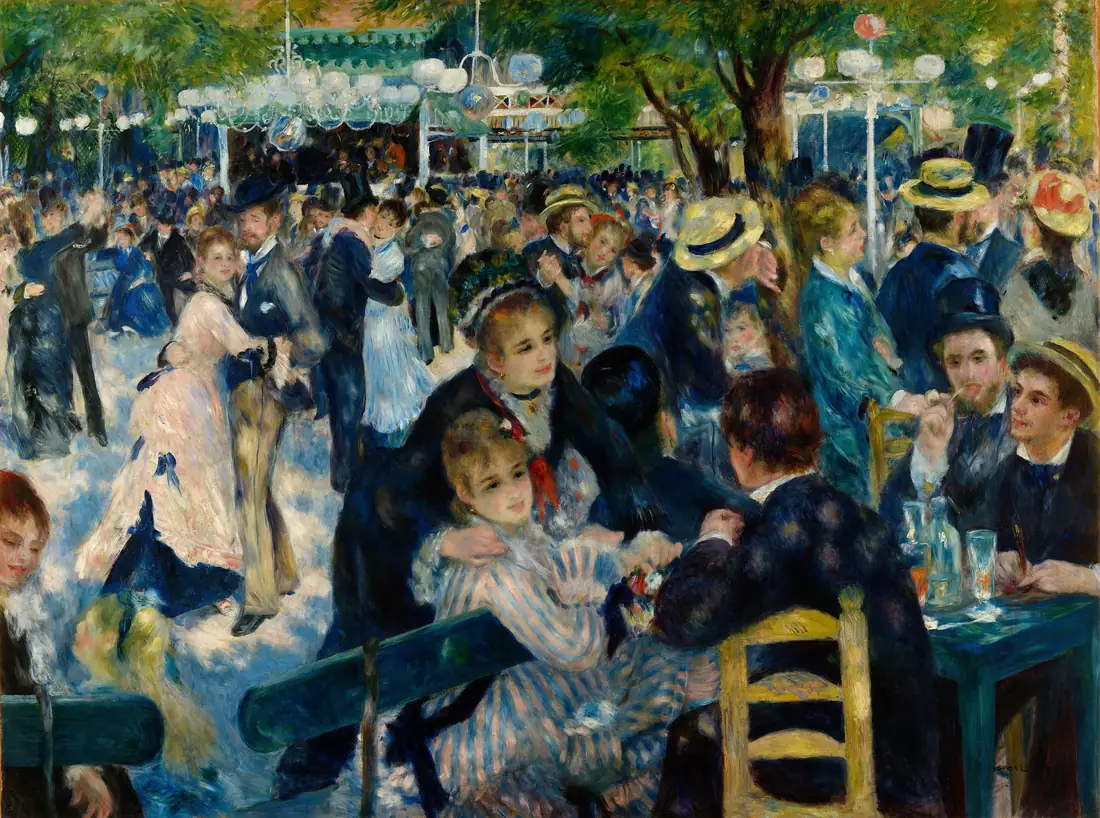
皮埃尔-奥古斯特·雷诺阿《煎饼磨坊的舞会》

煎饼磨坊的舞会Dance at Le Moulin de la GaletteBal du moulin de la Galette

皮埃尔-奥古斯特·雷诺阿 Pierre-Auguste Renoir
1876 年 · 布面油画 · 131 × 175 cm
巴黎,奥赛博物馆

Pierre-Auguste Renoir
1876 · Oil on canvas · 131 × 175 cm
Musée d’Orsay, Paris

这是蒙马特山顶一家露天舞厅的周日下午,来跳舞的有工人、女裁缝和画家。雷诺阿请朋友们来当模特;据朋友回忆,他们常常帮他把大画布抬到现场去画。

This is a Sunday afternoon at an open-air dance hall at the top of Montmartre, crowded with workers, seamstresses and painters. Renoir asked his friends to pose; by one friend’s account, they often helped him carry the big canvas to the spot.

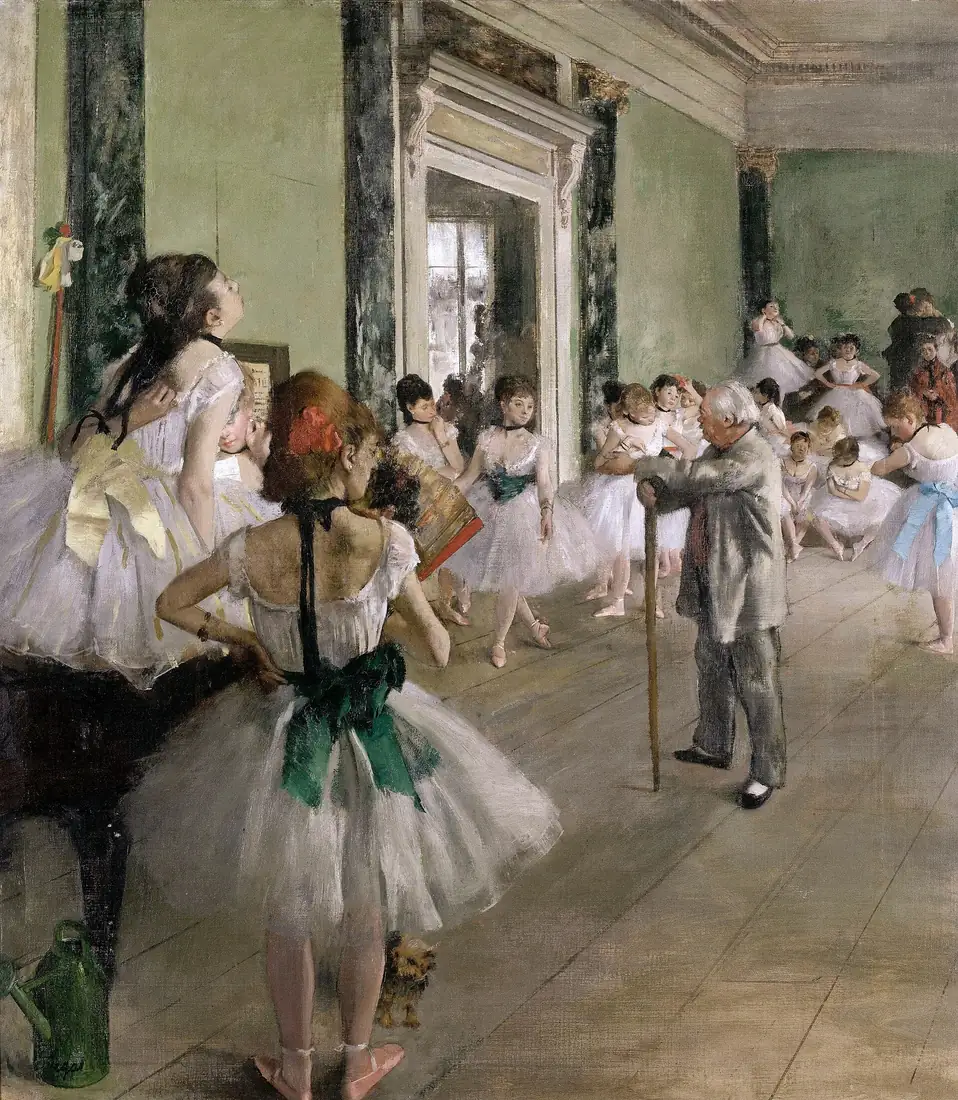
埃德加·德加《舞蹈课》

舞蹈课The Dance ClassLa Classe de danse

埃德加·德加 Edgar Degas
1873–1876 年 · 布面油画 · 85 × 75 cm
巴黎,奥赛博物馆

Edgar Degas
1873–1876 · Oil on canvas · 85 × 75 cm
Musée d’Orsay, Paris

德加不喜欢被叫作印象派,他自称“现实主义者”,也很少在户外作画。他一生画了上千件和芭蕾有关的作品,最爱画的是排练和后台。

Degas disliked being called an Impressionist; he called himself a realist and rarely painted outdoors. He made more than a thousand works about ballet, and liked rehearsals and backstage best.

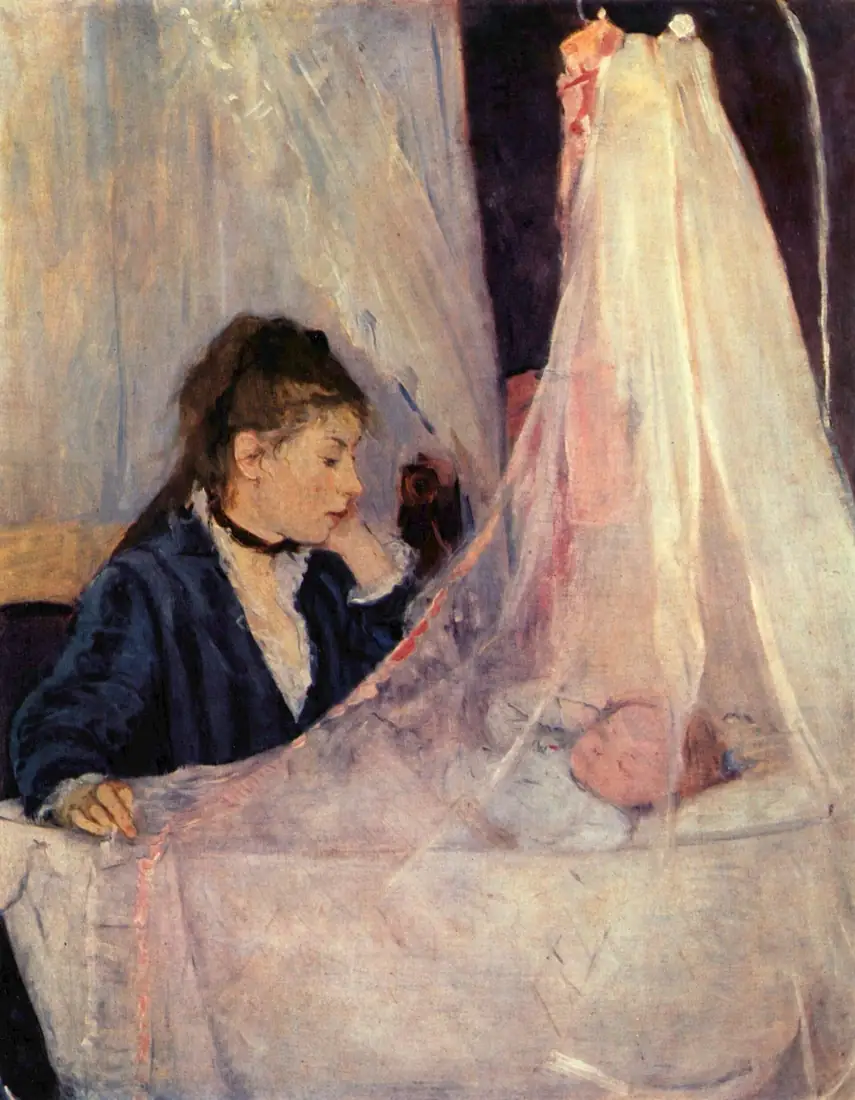
贝尔特·莫里索《摇篮》

摇篮The CradleLe Berceau

贝尔特·莫里索 Berthe Morisot
1872 年 · 布面油画 · 56 × 46 cm
巴黎,奥赛博物馆

Berthe Morisot
1872 · Oil on canvas · 56 × 46 cm
Musée d’Orsay, Paris

莫里索是印象派的创始成员之一,八次印象派展览她参加了七次。这幅画就挂在 1874 年的第一届展览上。

Morisot was a founding member of the Impressionists and showed in seven of their eight exhibitions. This painting hung in the first one, in 1874.

第 10 展厅Room 101886–1906巴黎 · 阿尔勒 · 圣雷米 · 艾克斯Paris · Arles · Saint-Rémy · Aix

结构与情感Structure and Feeling

后印象派Post-ImpressionismPost-Impressionism

印象派之后,几位曾和他们一同展出的画家开始不满足:光很美,可画面是不是太松散了?修拉想让色彩像科学一样精确,梵高想让颜色说出内心,塞尚想让自然重新变得像博物馆里的古典画一样坚实。

他们并没有统一的风格。“后印象派”这个名字,是英国评论家罗杰·弗莱 1910 年在伦敦办展时才起的。

After Impressionism, several painters who had shown alongside the group grew dissatisfied. The light was beautiful, but wasn’t the picture too loose? Seurat wanted colour as exact as science, Van Gogh wanted colour to speak from within, and Cézanne wanted nature to feel as solid as the old paintings in the museums.

They never shared a style. The name “Post-Impressionism” only arrived in 1910, when the English critic Roger Fry organised an exhibition in London.

  • 点彩Pointillism

    用纯色的小点并排排列,让颜色在观者眼中混合。

  • Pointillism

    Small dots of pure colour set side by side so that they blend in the viewer’s eye.

  • 表现性色彩Expressive colour

    颜色不再描述“看到了什么”,而是表达“感受到什么”。

  • Expressive colour

    Colour no longer describes what you see but expresses what you feel.

  • 几何化Geometric structure

    塞尚的名言:用圆柱体、球体和圆锥体来处理自然。

  • Geometric structure

    Cézanne’s famous advice: treat nature through the cylinder, the sphere and the cone.

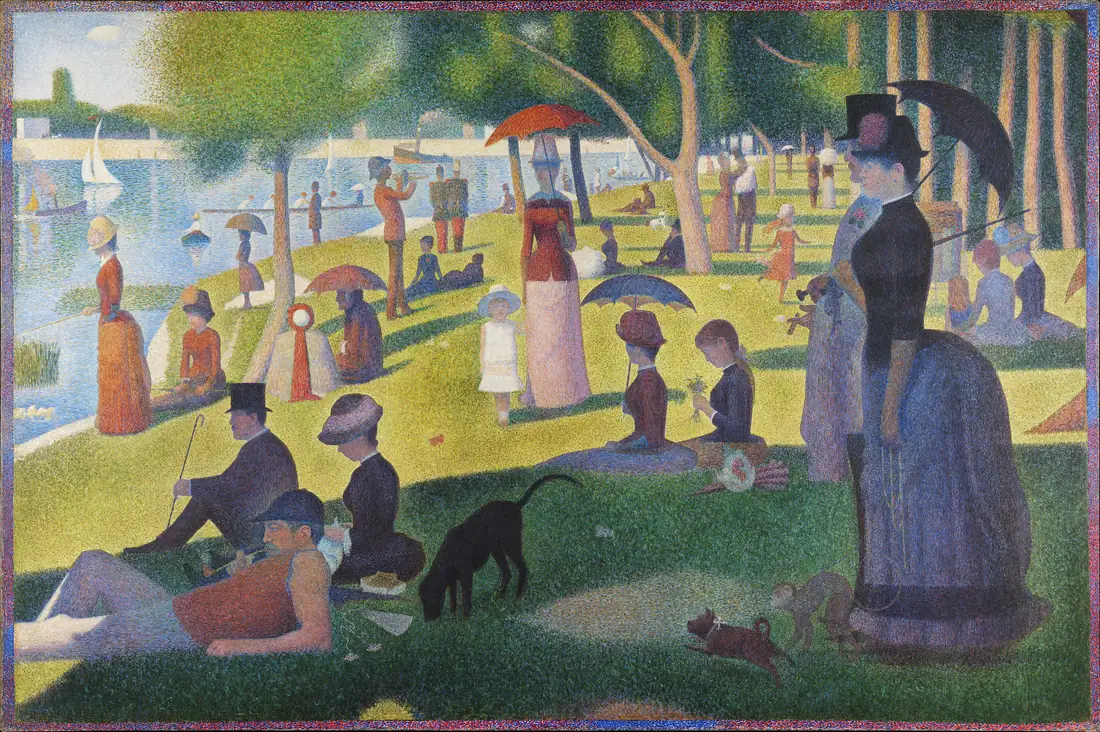
乔治·修拉《大碗岛的星期天下午》

大碗岛的星期天下午A Sunday Afternoon on the Island of La Grande JatteUn dimanche après-midi à l’Île de la Grande Jatte

乔治·修拉 Georges Seurat
1884–1886 年 · 布面油画 · 207.5 × 308.1 cm
芝加哥艺术博物馆

Georges Seurat
1884–1886 · Oil on canvas · 207.5 × 308.1 cm
Art Institute of Chicago

修拉为这幅画花了两年:先在塞纳河的大碗岛上画了几十张写生,再回到画室,用小色点一点点地“点”完。它在 1886 年最后一届印象派展览上展出,既是印象派的终点,也是新方向的起点。

Seurat spent two years on this painting: dozens of sketches made on the island of La Grande Jatte in the Seine, then back in the studio, dot by dot. It was shown at the last Impressionist exhibition in 1886, both the end of Impressionism and the start of something new.

实验台

Lab

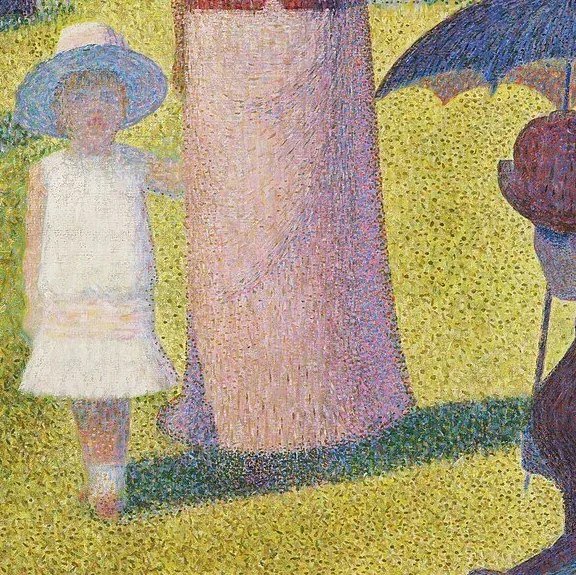
点彩实验台

Pointillism lab

拖动滑块“后退几步”,看纯色的小点怎样在眼睛里混合。

Drag the slider to step back, and watch dots of pure colour mix in your eye.

修拉《大碗岛的星期天下午》局部
修拉原作局部Seurat’s original (detail)
用 11 种纯色重新点出Redone in 11 pure colours

左边是修拉原作的一块局部。右边用 11 种纯色颜料把同一块画面重新“点”了一遍:近看是一颗颗互不相干的色点,退远后,它们在眼睛里混合成草地、阴影和皮肤。

修拉相信,在眼睛里混合的颜色比在调色板上调出来的更明亮。实际效果没有他期望的那么亮,但这种方法改变了后来的许多画家。

On the left is a detail of Seurat’s original. On the right the same patch is redone in dots of 11 pure pigments: up close they are separate dots; from a distance they mix in the eye into grass, shadow and skin.

Seurat believed that colours mixed in the eye are brighter than colours mixed on the palette. The effect was not as bright as he hoped, but the method changed many of the painters who came after him.

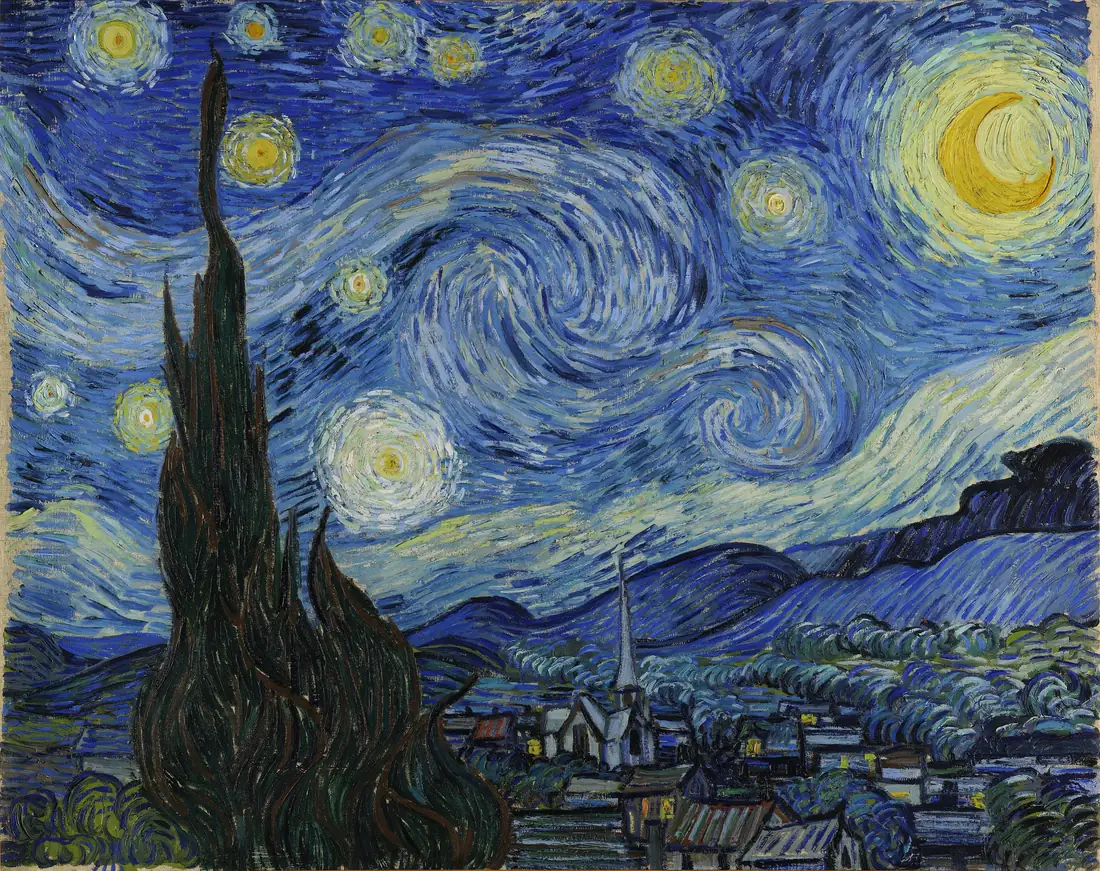
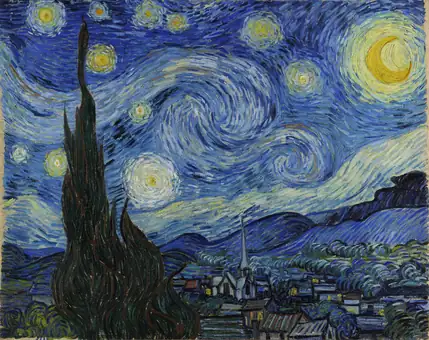
文森特·梵高《星月夜》

星月夜The Starry NightDe sterrennacht

文森特·梵高 Vincent van Gogh
1889 年 · 布面油画 · 73.7 × 92.1 cm
纽约,现代艺术博物馆

Vincent van Gogh
1889 · Oil on canvas · 73.7 × 92.1 cm
Museum of Modern Art, New York

1889 年 6 月,梵高住在法国南部圣雷米的一家精神病院里。他从卧室窗口看着黎明前的天空,然后在画室里凭记忆和想象画下了它。一年多以后,他去世了。

In June 1889 Van Gogh was living in an asylum at Saint-Rémy in the south of France. He watched the sky before dawn from his bedroom window, then painted it in his studio from memory and imagination. A little over a year later he was dead.

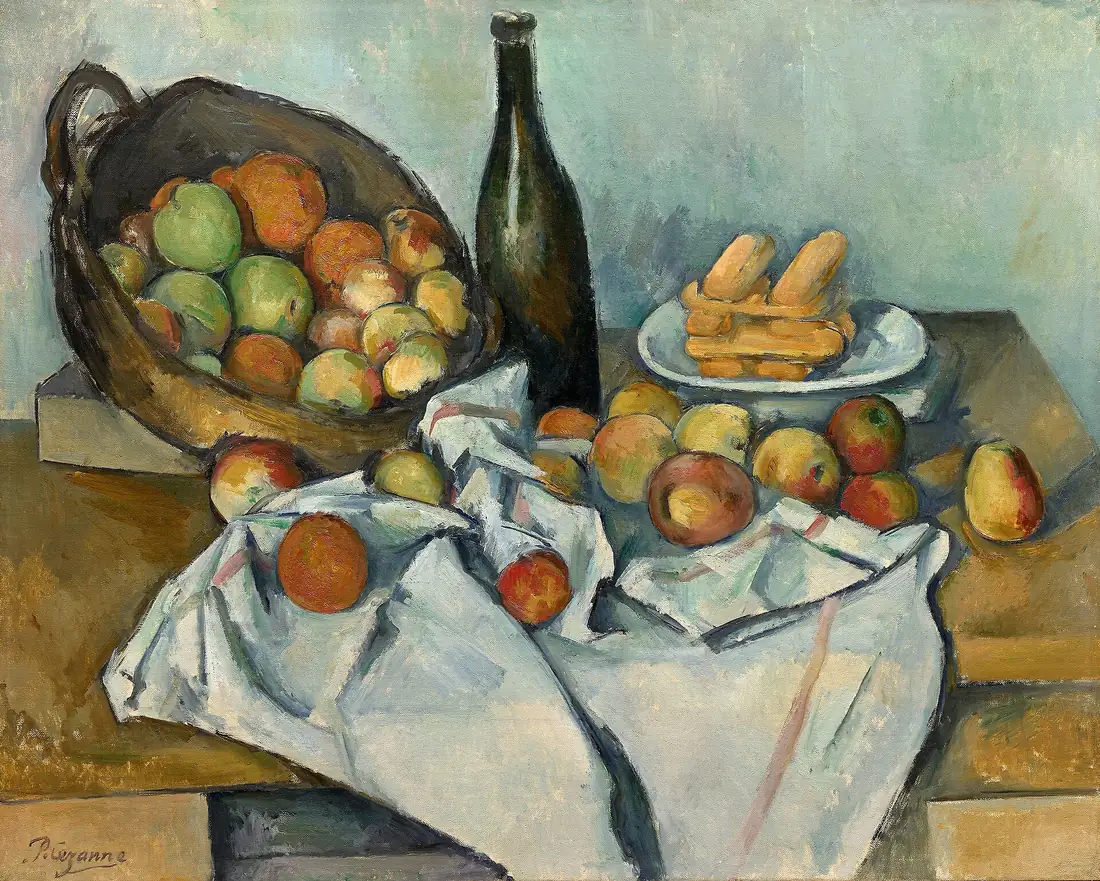
保罗·塞尚《苹果篮》

苹果篮The Basket of ApplesLe Panier de pommes

保罗·塞尚 Paul Cézanne
约 1893 年 · 布面油画 · 65 × 80 cm
芝加哥艺术博物馆

Paul Cézanne
c. 1893 · Oil on canvas · 65 × 80 cm
Art Institute of Chicago

塞尚说过:“我要用一个苹果震惊巴黎。”他的静物看起来笨拙、歪斜,但这些“不对”大多是有意的:他想画的不是某一瞬间的样子,而是物体在我们心里的分量。

Cézanne said: “I want to astonish Paris with an apple.” His still lifes look clumsy and crooked, but the mistakes are mostly deliberate: he wanted to paint not how a thing looks at one instant but its weight in our mind.

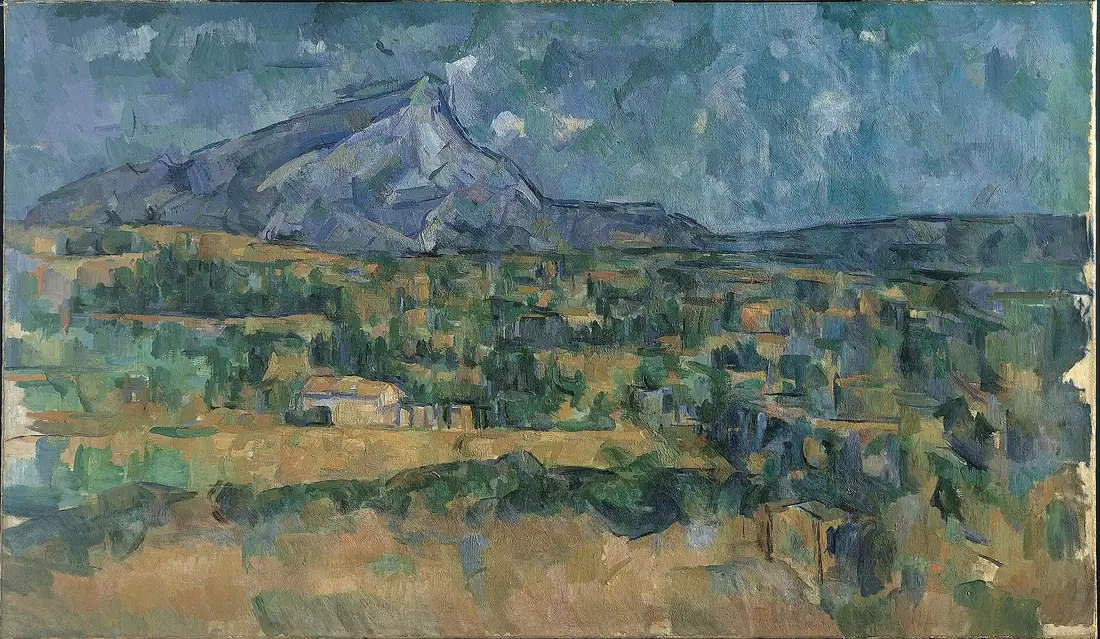
保罗·塞尚《圣维克多山》

圣维克多山Mont Sainte-VictoireLa Montagne Sainte-Victoire

保罗·塞尚 Paul Cézanne
1902–1906 年 · 布面油画 · 56.6 × 96.8 cm
纽约,大都会艺术博物馆

Paul Cézanne
1902–1906 · Oil on canvas · 56.6 × 96.8 cm
Metropolitan Museum of Art, New York

家乡艾克斯附近的这座山,塞尚画了几十遍。晚年他几乎每天走到山对面的高地上写生。

Cézanne painted this mountain near his home town of Aix dozens of times. In his last years he walked almost every day to the high ground opposite to paint it.

尾声 · 1907

Epilogue · 1907

1906 年 10 月,67 岁的塞尚在野外写生时遇上暴雨,倒在路边,几天后去世。第二年,巴黎秋季沙龙为他办了一场回顾展。

年轻的毕加索和布拉克看过之后,开始把画面拆成碎片,立体主义由此诞生。后来流传着一句话:塞尚是“我们所有人的父亲”。

从乔托让圣母有了重量,到塞尚让一只苹果有了重量,那扇用了六百年的“窗”终于被打碎。此后的故事,属于现代艺术。

In October 1906 the 67-year-old Cézanne was caught in a storm while painting outdoors. He collapsed by the road and died a few days later. The next year, the Salon d’Automne in Paris held a retrospective of his work.

After seeing it, the young Picasso and Braque began breaking the picture into fragments, and Cubism was born. A saying went round afterwards: Cézanne was “the father of us all”.

From Giotto giving the Virgin weight to Cézanne giving an apple weight, the window that had served for six hundred years was finally shattered. What came next belongs to modern art.